Dealing with a landlord dispute can be stressful, especially when you've moved out, cleaned the place, returned the keys, and still don't have your money. If you're searching for answers about a landlord not returning security deposit Texas dispute, you're probably trying to figure out whether your landlord is stalling, whether you missed a step, and what you can do next.
Texas law gives tenants real tools to recover a security deposit, but the details matter. One overlooked mistake, especially with your written forwarding address, can change the legal timeline. If you understand the Texas Property Code, keep the right records, and push your claim the right way, you put yourself in a much stronger position.
Facing a Withheld Security Deposit
You finish your move-out. The apartment is empty. You took out the trash, patched a few nail holes, and dropped off the keys at the office. You expect your deposit back within a month.
Then nothing happens.
A week passes. Then another. You check the mail, refresh your email, and wonder whether the landlord is ignoring you. Many Texas tenants end up in exactly this spot, and the uncertainty is often worse than the amount in dispute. You know the money matters, but you may not know whether the landlord is allowed to wait, deduct charges, or stay silent.
Here's the good news. Texas Property Code gives you a path forward. You can look at the deadline, confirm whether you properly triggered it, gather proof, send a clear demand letter, and, if needed, file in Justice Court. That process can work whether you're handling the matter yourself or speaking with a Texas landlord tenant lawyer or eviction attorney for guidance.
Practical rule: Don't start with accusations. Start with documents. Courts care much more about your paper trail than your frustration.
A common example looks like this: a tenant moves out on the last day of the lease, leaves the unit in decent condition, and hears nothing from the landlord. Later, the landlord claims there was damage, but never sent an itemized list. In many cases, the primary issue isn't just the condition of the property. It's whether the tenant gave a forwarding address in writing and whether the landlord followed the law after receiving it.
That's where most confusion begins, and where many deposit disputes are won or lost.
Understanding Texas Security Deposit Law
Texas security deposit disputes often hinge on two overlooked triggers: the moment the landlord receives your forwarding address, and whether any deductions were explained with a proper written itemized list. Those details sound small. In practice, they often decide whether a tenant has a routine refund issue or a stronger claim under the Texas Property Code.
The core statutes are Texas Property Code § 92.103 and § 92.109. If you want the larger context, Texas Landlord-Tenant Law: An Overview explains how these deposit rules fit into the broader Texas rental framework.
What Section 92.103 means in plain English
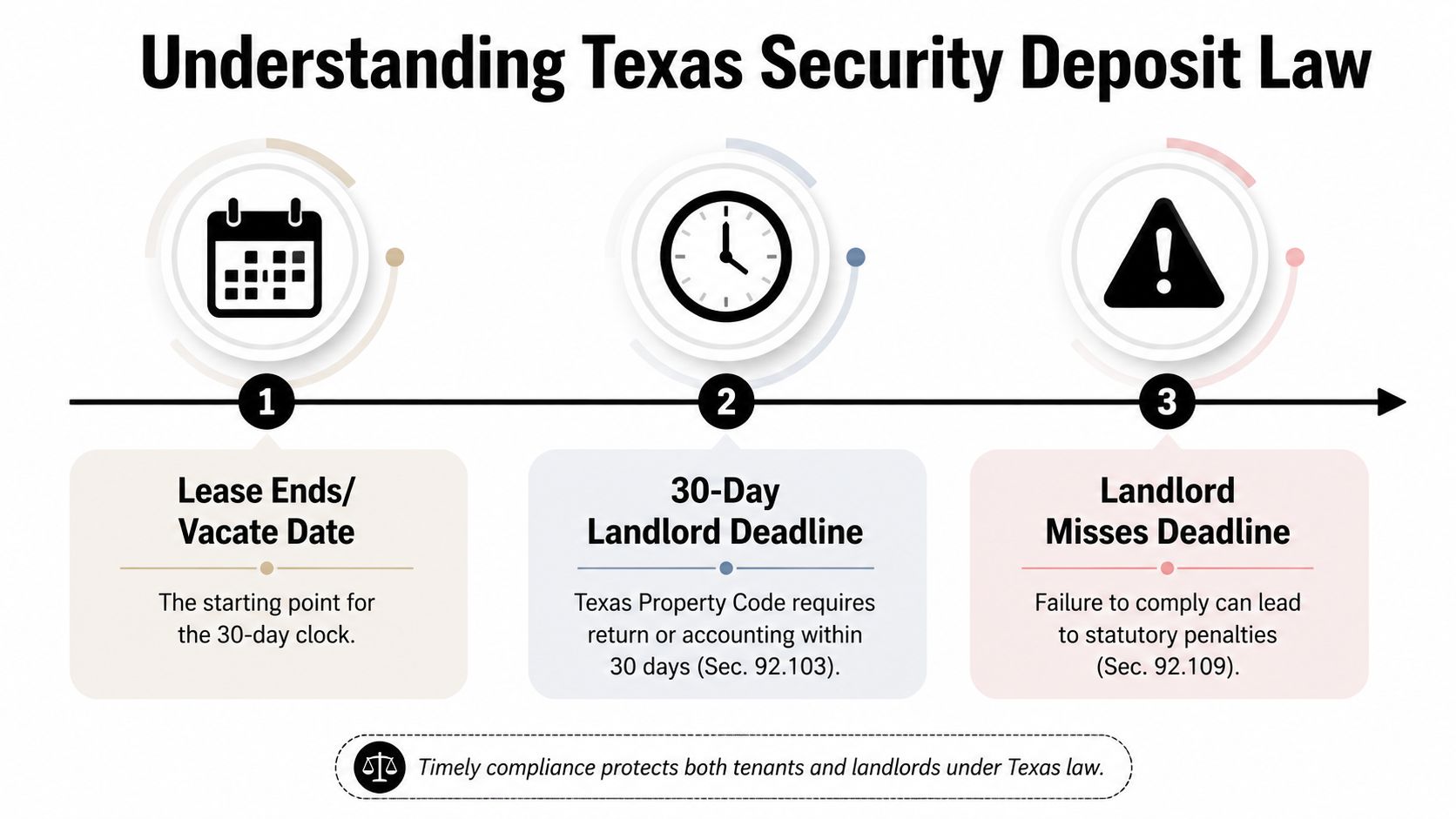
Under Texas Property Code § 92.103, a landlord generally must return the security deposit or send an accounting of deductions within 30 calendar days after the tenant surrenders the premises. But there is a trigger many tenants miss. The landlord's deadline does not start until the landlord receives the tenant's written forwarding address, as explained in Texas Tenant security deposit guidance.
A simple way to understand it helps. Surrendering the unit is one key. Giving a written forwarding address is the second key. Texas law usually requires both before the 30 day clock starts running.
That is why a tenant can move out on time, return the keys, and still wait longer than expected if no written forwarding address was sent, or if the tenant cannot prove it was sent.
The forwarding address problem tenants often miss
Take a common example. A tenant moves out on March 1, drops off the keys, and assumes the deposit is due by the end of March. Then the tenant sends a forwarding address in writing on June 1. In that situation, the landlord may argue the 30 day period ran from June 1, not March 1.
That does not mean every landlord delay is lawful. It means proof matters. If your forwarding address was sent by email, certified mail, portal message, or another written method you can later produce, your position is much stronger than if you only told someone at the leasing office.
A practical habit for future rentals helps here too. Keeping a move-in condition record and written move-out file can prevent side disputes over damage. Many tenants use a tenant move-in checklist template so they are not trying to reconstruct facts months later.
The itemized list loophole many guides gloss over
Texas law does not just focus on whether the landlord kept money. It also focuses on whether the landlord followed the right process when keeping it.
If the landlord keeps any part of the deposit, the landlord usually must provide a written description and itemized list of deductions. That requirement matters because vague statements like "cleaning," "repairs," or "damages" may leave room to challenge whether the withholding was proper. An itemized list should tell you what was charged and why.
This is one of the most common pressure points in a case. A landlord may believe deductions were justified, but still weaken the defense by sending no written itemization, sending it late, or sending a list so general that it does not explain the charges in a meaningful way.
Related property-condition disputes can overlap with other legal duties. If a landlord blames infestation or sanitation problems for deductions, it helps to understand how Texas repair and pest issues are analyzed, including understanding landlord bed bug rules.
What happens if the landlord misses the deadline
Under Texas Property Code § 92.109, a landlord who retains a security deposit in bad faith can face more than a simple order to return the money. Texas law allows a tenant to seek statutory remedies that may include $100, three times the portion wrongfully withheld, reasonable attorney's fees, and court costs, as summarized in DoorLoop's Texas security deposit law overview.
Bad faith is a legal conclusion, not just a feeling that the landlord acted unfairly. Courts often look closely at timing, the forwarding address issue, the existence or absence of an itemized list, and whether the claimed deductions match the actual condition of the unit. That is why tenants should avoid skipping over "technical" details. In Texas deposit cases, those technical details often carry the whole claim.
Gathering Evidence and Estimating Your Claim
A security deposit case is often won or lost on paper. Texas judges usually want a simple timeline they can follow: you paid the deposit, you moved out, you gave a forwarding address, and the landlord either kept money without adequate support or failed to send the required paperwork. If one link in that chain is missing, the case gets harder.
The forwarding address piece is easy to overlook, but in Texas it acts like the switch that turns the landlord's return duty on. Tenants sometimes focus only on photos of the apartment and forget the legal trigger. If you cannot show that the landlord received your forwarding address, a strong condition argument may still run into a timing problem.
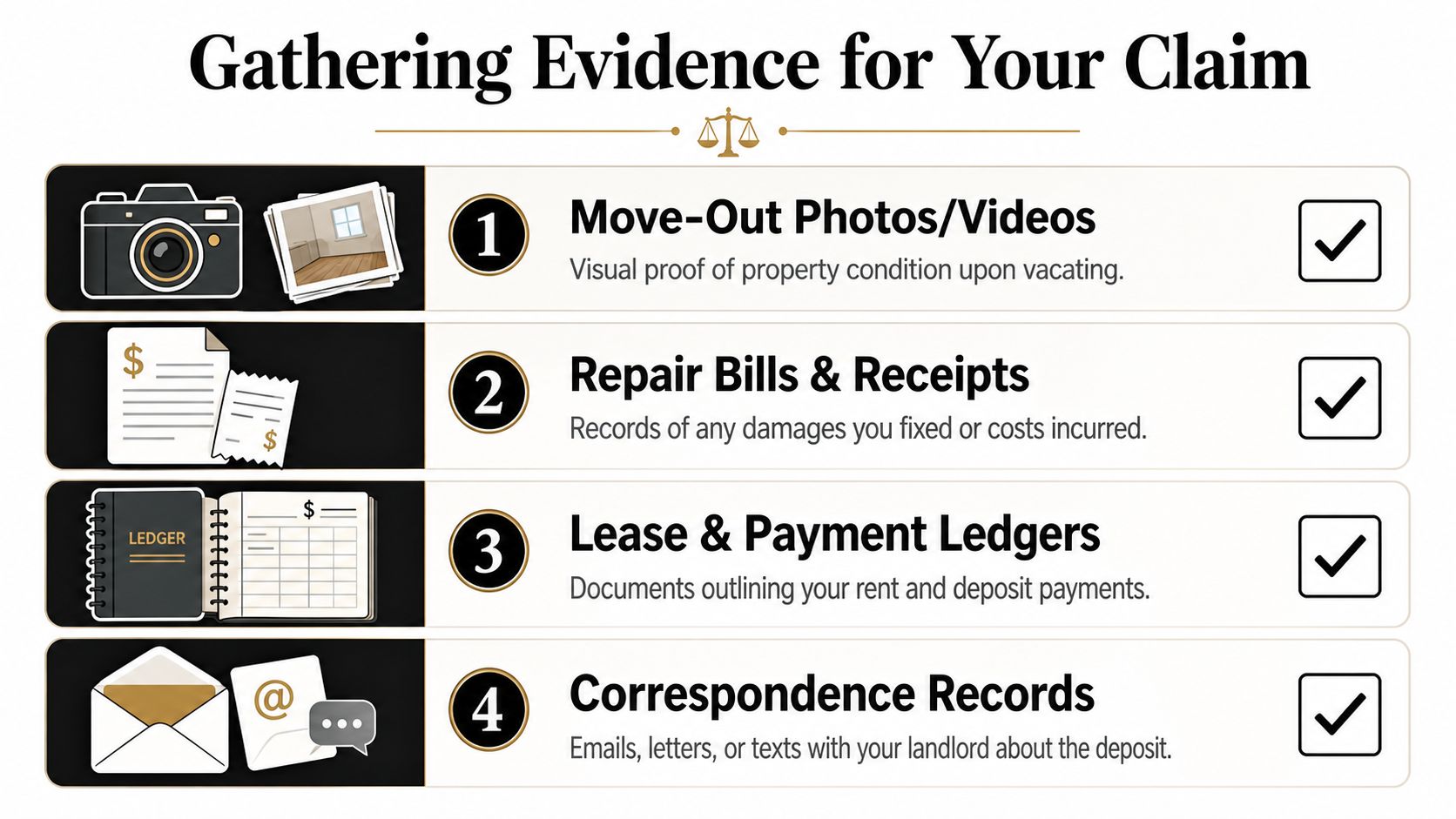
Start by building a file that answers four basic questions:
- What did you pay? Keep the signed lease, deposit receipt, payment confirmation, or account ledger showing the deposit amount.
- What condition was the unit in when you left? Save move-out photos and videos of each room, inside appliances, floors, walls, bathrooms, blinds, and any area the landlord may later mention.
- When did the landlord get your forwarding address? Keep the email, letter, portal message, certified mail receipt, or text that shows the address was sent and received.
- What explanation did the landlord give, if any? Save itemized deductions, envelopes, emails, text messages, repair invoices, and any message about cleaning, damage, or unpaid rent.
Move-in proof matters too. A case is much easier when you can compare the property's condition at the beginning and the end of the lease, almost like a before-and-after set of snapshots. If you completed a checklist at move-in, keep it with your file. If you did not, a tenant move-in checklist template for future rentals shows the kind of details that help prevent these disputes.
A practical way to organize the file
Use one folder, either digital or paper, and sort everything by date. Rename photos by room and date if you can. For example, “kitchen_moveout_May12” is far more useful than “IMG_4837.” That small step can save you real frustration if you end up attaching exhibits to a demand letter or showing them to a judge.
A short case chart helps keep the story clear:
| Item | Why it matters |
|---|---|
| Lease | Identifies the parties and the deposit terms |
| Deposit payment proof | Shows the amount you actually paid |
| Forwarding address notice | Shows when the landlord's duty to return or itemize was triggered |
| Move-in checklist or photos | Helps separate preexisting issues from claimed damage |
| Move-out photos | Counters exaggerated cleaning or repair claims |
| Itemized deduction list, if any | Shows whether the landlord explained charges with enough detail |
| Rent ledger or payment history | Rebuts claims of unpaid rent |
Keep copies of anything you send. If the landlord later says, “I never got your address” or “I mailed the list,” your records will matter more than anyone's memory.
Estimating your claim without guessing
Begin with the amount of the deposit still being withheld. Then ask two follow-up questions. Did the landlord send a written itemized list, if one was required? Did the landlord do so on time after receiving your forwarding address?
Many tenants often miss a strong argument. The problem is not always just that money was withheld. Sometimes the stronger point is that the landlord never sent a legally adequate explanation. A vague line such as “repairs” or “cleaning” may not help much if it does not tell you what was done and why the charge was taken from your deposit.
As noted earlier, Texas law can create serious consequences for bad-faith withholding, including statutory damages tied to the amount wrongfully withheld. You do not need to calculate the maximum possible recovery with perfect precision at this stage. For your working estimate, list:
- The unpaid deposit balance
- Any deductions you believe were unsupported
- Whether no itemization was sent, it was sent late, or it was too vague to be meaningful
- Your filing costs if you end up suing
If the landlord claims unpaid rent, slow down and test that claim carefully. Ask yourself whether the ledger matches your payment records, whether any concession or partial-month agreement existed, and whether the landlord is using “unpaid rent” as a catch-all excuse. In many Texas deposit disputes, the rent ledger is as important as the photos.
A real-world example
Suppose you paid a $1,500 deposit, moved out on May 31, emailed your forwarding address that same day, and took clear photos showing the unit was clean. By July, no refund and no itemized list had arrived. In that situation, your claim is not just “I want my deposit back.” Your claim becomes much cleaner: you can show the deposit amount, the date the landlord received the forwarding address, the condition of the unit, and the absence of a proper response.
That kind of file gives you credibility. Credibility often decides close cases.
Crafting and Sending a Demand Letter
A good demand letter can solve a deposit dispute before court. It tells the landlord you understand your rights, have your records in order, and are prepared to act if the matter isn't resolved.

What to include in the letter
Keep the tone professional. Don't make it emotional. Include:
- Your identifying information. Name, former rental address, move-out date, and forwarding address.
- Deposit details. State the amount paid and what has not been returned.
- Key legal point. Refer to the landlord's duty under the Texas Property Code to return the deposit or provide written itemization.
- What happened. Briefly explain whether no refund arrived, no itemized list arrived, or deductions were unsupported.
- Your demand. Ask for payment by a specific date and state that you may file in Justice Court if the matter isn't resolved.
- Attachments. Mention any move-out photos, proof of forwarding address, and payment records you're including.
If you want a structured starting point, this Texas demand letter resource can help you format the letter clearly.
Sample language you can adapt
I was the tenant at [rental address]. I surrendered the premises on [date] and provided my written forwarding address on [date]. My security deposit has not been returned, and I have not received a legally sufficient written itemization of deductions. Please remit the balance owed to me by [date]. If this matter is not resolved, I may pursue available remedies under the Texas Property Code.
That's enough. Short is better than dramatic.
How to send it
Send the letter in a way you can prove later. Certified mail is often useful because it creates a paper trail. Email can also help because it preserves the text and timestamp. Many tenants use both.
This video gives additional practical context on handling landlord disputes and written demands:
What not to do
Avoid threats you don't understand. Don't exaggerate facts. Don't send a five-page argument full of side issues like old maintenance complaints unless they directly matter to the deposit.
If your file is messy or the landlord is represented by counsel, this is one point where speaking with a Texas landlord tenant lawyer may save time. The Law Office of Bryan Fagan, PLLC handles landlord-tenant disputes involving deposits, lease enforcement, and related Texas Property Code issues, and legal review can be useful before you file suit.
Filing in Small Claims Court
If the demand letter doesn't work, many Texas tenants bring deposit cases in Justice Court, often called small claims court. The process is meant to be accessible, but you still need to be organized.
The basic filing path
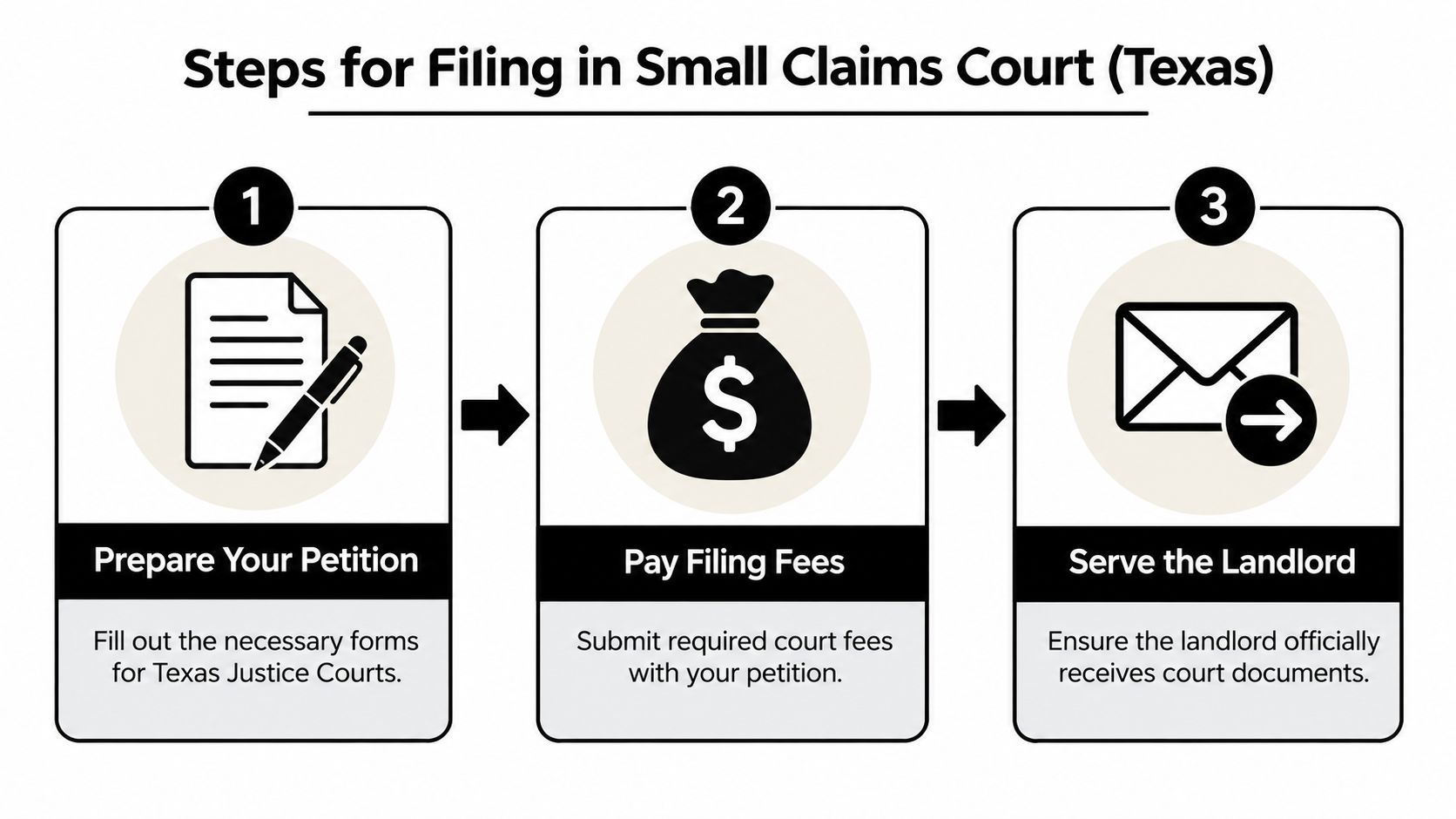
You'll usually move through three practical stages.
| Stage | What you do |
|---|---|
| Petition | Fill out the court form with the parties, facts, and requested relief |
| Filing | Submit the papers and pay the court's filing costs |
| Service | Make sure the landlord is formally served |
For a focused walkthrough, review this guide on small claims court for landlord deposit disputes.
What to put in your petition
Be direct. State that you rented the property, paid a security deposit, moved out, provided a forwarding address, and did not receive the refund or required accounting. Attach or bring the documents that support each point.
Don't overload the petition with unrelated complaints. A judge wants the core facts fast.
What to bring to the hearing
Bring a clean packet with copies for yourself, the judge, and the landlord if required by the court. Include:
- The lease
- Proof of deposit payment
- Written forwarding address evidence
- Move-out photos
- Demand letter and proof of delivery
- Any landlord response or itemization
- Ledger records if rent is disputed
Judges often decide these cases on sequence and credibility. If your documents show a clear timeline, your presentation becomes much stronger.
How to present your case
When your hearing starts, tell the story in order. Don't jump around. Focus on dates, written notice, and whether the landlord complied with the Texas Property Code.
If the landlord argues there was damage, ask where the photographs, invoices, or receipts are. If the landlord argues unpaid rent, ask for the ledger. If the landlord argues you never gave a forwarding address, show the written proof first. That single issue often controls more than tenants realize.
This is also where an eviction attorney or landlord-tenant counsel can help, even though the case is about a deposit rather than an eviction. The courtroom skills are similar. Evidence, timing, and statutory language matter.
Responding to Landlord Defenses and Next Steps
Most landlords don't say, “I kept the deposit for no reason.” They usually raise a defense. The strongest response is calm, document-based, and specific.
Common defenses include these:
- Property damage. Answer with move-in and move-out photos, repair receipts, and the lease language.
- Unpaid rent. Ask for the ledger and compare it to your payment records.
- No forwarding address. Produce your written notice and delivery proof.
- No itemization required. Challenge that claim if the landlord can't back it up with records.
One issue deserves special attention. Texas law may excuse itemization in some unpaid-rent situations, but courts often look hard at whether the landlord can prove the rent deficiency with ledgers and records. If the paperwork is weak, that defense may not hold.
If your case is straightforward, you may be able to handle it on your own. If the facts are disputed, the landlord has counsel, or the amount matters enough that you want strategic help protecting your tenant rights, legal advice is usually worth getting sooner rather than later.
If you need help with a security deposit dispute, lease issue, eviction matter, or other rental conflict, contact The Law Office of Bryan Fagan, PLLC for a free consultation today. A Texas landlord tenant lawyer can review your documents, explain your rights under the Texas Property Code, and help you decide whether to negotiate, send a stronger demand, or move forward in court.