Dealing with a sudden move, a dangerous apartment, or a lease you can't afford anymore is stressful. Most tenants don't start by asking how to get out of an apartment lease early in Texas. They start with a job transfer, a breakup, a stalking concern, a landlord who won't fix serious problems, or a new place they need to be fast.
That pressure leads people into expensive mistakes. They rely on a verbal conversation with the leasing office. They turn in keys without written notice. They assume a bad repair situation automatically lets them move out. Then a demand letter arrives for rent, fees, or a damaged rental history.
Texas law gives some tenants real ways out. But the details matter. Procedure matters just as much as the reason you want to leave. If you skip a required step, a good argument can turn into a lease debt.
Feeling Trapped by Your Texas Lease Agreement
A common situation looks like this. Your lease still has months left. You need to leave now. You call the apartment office, explain what's happening, and someone says they'll “note the file.” That feels like progress until you learn later that nothing was approved in writing.
Another version is even harder. The unit has mold, no working repair response, broken locks, or another condition affecting your safety. You assume the landlord breached first, so you can just move out. In Texas, that assumption can cost you.
Practical rule: A lease problem is rarely solved by a conversation alone. It's solved by the lease language, the Texas Property Code, and the paper trail you can prove later.
Feeling stuck doesn't mean you've done anything wrong. Life changes. Leases don't. The question is whether you have a legal termination right, a contractual buyout option, or a negotiated exit.
If you're a tenant, your goal is to leave without creating a larger problem. If you're a landlord or property manager reading this, the same rules matter because Texas law controls what can be charged and enforced. A Texas landlord tenant lawyer looks at the facts in that order, not by guessing what the front office usually does.
Your First Step Reviewing Your Lease Agreement
Before you send notice or move anything, pull the full signed lease and read the termination sections line by line. Don't rely on memory. Don't rely on what a staff member said at move-in. Your lease often answers the first set of practical questions.
What to find in the lease
Look for sections labeled:
- Early termination. This may describe a buyout process, required notice, and what must be paid before the lease ends.
- Reletting or replacement tenant. Some leases separate a buyout from the landlord's effort to re-rent.
- Notice requirements. The lease may state where notice must be sent and what delivery method counts.
- Default and remedies. Hidden liability often appears if you leave without following the contract.
- Concessions or specials. If you received free rent, a discounted first month, or another move-in incentive, check whether the lease says that benefit is lost if you leave early.
A useful background reference on lawful exit grounds is Lease Termination and Breaking a Lease in Texas, which discusses the lawful grounds for ending a Texas lease early for both parties.
The hidden cost many tenants miss
One of the most overlooked clauses is the concession payback term. A growing trend in Texas apartment leases is the “concession payback” clause, which can retroactively void signing incentives like “one month free rent” if you break the lease, potentially adding $1,000–$2,500 to your exit costs, as noted in a Texas renter discussion on breaking a lease in Texas.
That matters because a tenant may budget for an early termination fee and completely miss the bigger charge hiding in the concessions section.
For example, a tenant may think, “I'll pay the lease-break fee and be done.” Then the ledger includes recaptured free rent, application incentives, or other move-in credits. The lease may treat those as conditional benefits that disappear once you leave early.
Read it like a dispute file
As you review the lease, make a short checklist:
- What exact notice does the lease require
- Does it allow a buyout
- Does it mention reletting
- Are concessions recaptured
- Does it require written approval for subletting or assignment
If the lease gives the landlord discretion, assume you need written approval. Verbal permission is fragile evidence.
That first review tells you whether you're dealing with a legal right, a contract exit, or a negotiation problem.
When Texas Law Allows You to Break a Lease
Some tenants don't need to negotiate because Texas law gives them a direct termination right.
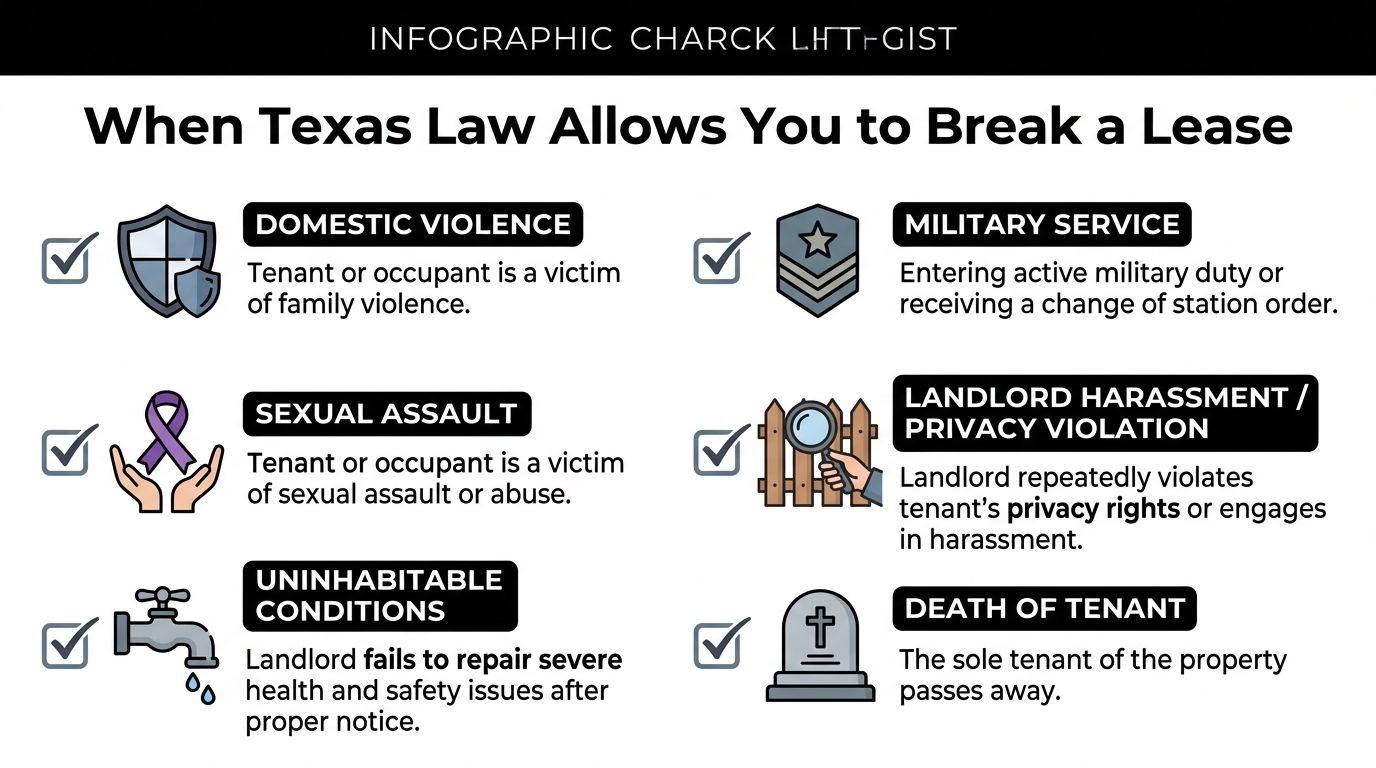
Family violence sexual assault and stalking
Under Texas Property Code Section 92.016, victims of family violence, sexual assault, or stalking can terminate a lease early by providing written notice and valid documentation, such as a protective order. This protection allows them to escape unsafe housing without liability for future rent, as explained by Texas Law Help on early lease termination for victims of family violence.
This is one of the clearest statutory protections in Texas tenant rights law. The documentation requirement matters. So does timing. In some situations, the law allows immediate action when the abuser is a co-tenant or occupant.
Other situations tenants ask about
Texas tenants also often ask about military moves, severe repair failures, harassment, privacy violations, and the death of a sole tenant. Those situations can involve different legal rules, lease terms, or both. A practical overview of recognized grounds appears in reasons to break a lease in Texas.
Here is the practical difference:
| Situation | Main issue |
|---|---|
| Statutory termination right | You may have a direct legal exit if you meet the proof and notice rules |
| Landlord breach | You may still need formal procedure and possibly court action |
| Personal life change | Usually requires contract terms or negotiation, not automatic release |
What works and what doesn't
What works is gathering the exact proof the statute or lease calls for, then giving written notice in a way you can prove.
What doesn't work is assuming your reason is obvious enough that the landlord must release you.
Your stress may be urgent. The law still expects documentation.
If your situation involves danger, stalking, or violence, focus first on safety. Then make sure your notice and supporting records are complete. That combination protects both your physical safety and your legal position.
Forcing a Landlord to Uphold Their Duties
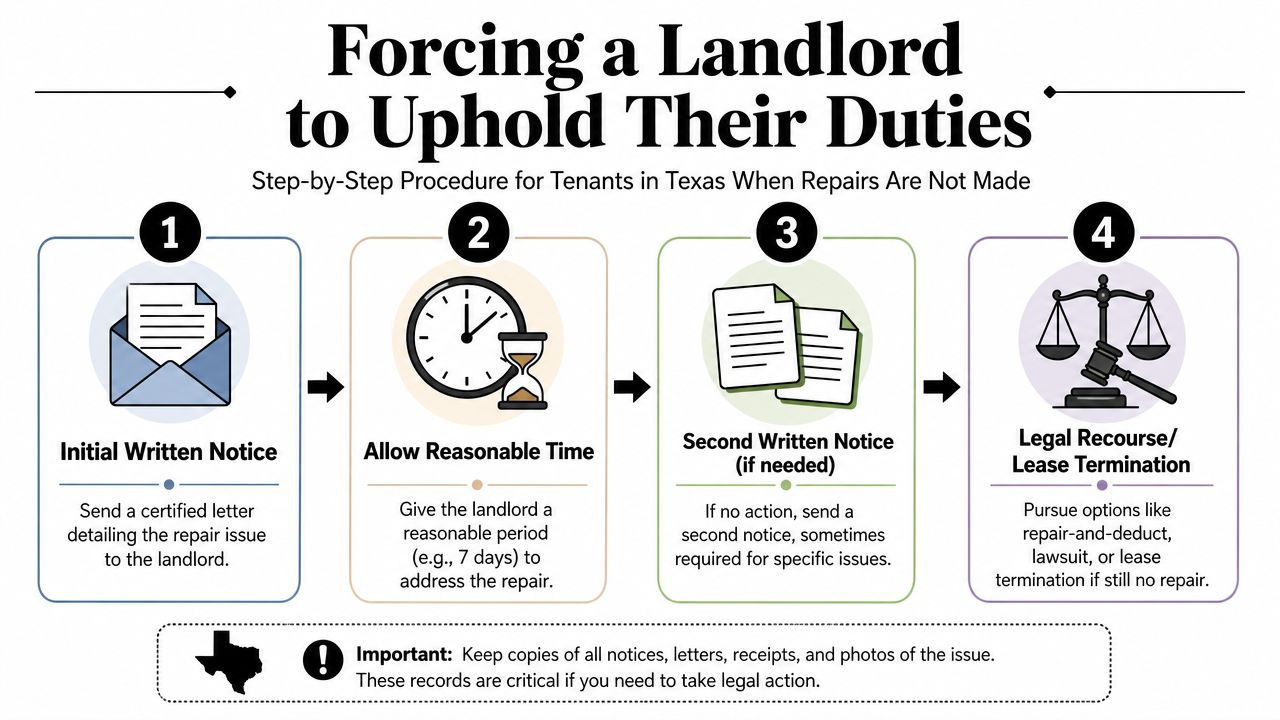
A common call goes like this: the apartment has mold, the AC has failed in extreme heat, or sewage is backing up, and the tenant assumes that means the lease is over. In Texas, the condition may justify strong remedies, but the tenant usually has to earn those remedies by following the procedure exactly.
The repair issue must qualify under Texas law
Texas draws a hard line between unpleasant living conditions and conditions that materially affect physical health or safety. The rules are explained in these habitability laws in Texas and what landlords must provide.
A related resource, The Landlord's Duty to Repair in Texas, addresses when a landlord must repair conditions affecting health or safety under 92.052.
That distinction matters because tenants lose good cases by treating every repair problem the same. Peeling paint, worn carpet, or a broken appliance may support a complaint, but they usually do not support early termination. Lack of heat, dangerous wiring, major water intrusion, raw sewage, or another serious health and safety issue may.
Procedure decides whether you have leverage
Under Texas Property Code Sections 92.056 and 92.0561, the tenant's paper trail often matters as much as the condition itself. Verbal complaints rarely carry enough weight. Email may help, but certified mail is often the safer move because it gives you proof of what was sent and when it was sent.
The usual traps are predictable:
- The notice is too vague. Identify the exact condition, where it is, when it started, and how it affects health or safety.
- The notice method is weak. Send a dated written notice by certified mail and keep the receipt.
- The tenant is behind on rent. A tenant in default often loses repair-based remedies.
- The tenant moves out too soon. The landlord usually must get a reasonable chance to repair after proper notice.
- The file is thin. Keep photos, videos, maintenance requests, inspection reports, and names of anyone you spoke with.
One more financial trap deserves attention. Tenants sometimes move out over a serious repair problem, then get hit with rent claims, reletting charges, and even concession payback demands because they ended the lease before the legal steps were complete. Being morally right about the condition does not always protect you from those charges.
Later in the process, this video may help frame the repair dispute issues tenants commonly face.
Many tenants still need court involvement
Even with strong facts, self-help is risky. In some cases, the tenant may need a court order before treating the lease as terminated. Texas Law Help on lease termination and ending your lease explains why a move-out without the required legal steps can still lead to a claim for unpaid rent.
Tenants often get trapped. They have real safety concerns. They also have an incomplete record, the wrong notice method, or no court order. The landlord then frames the case as an ordinary broken lease.
If you are preparing to leave because repairs were ignored, document the unit's condition carefully and also document how you leave it. That reduces one more avoidable dispute over cleaning or condition at surrender. For practical turnover standards used by property professionals, review these cleaning solutions for real estate professionals.
An eviction attorney or Texas landlord tenant lawyer can help assess whether the facts support repair remedies, termination, rent reduction, or a court filing.
Negotiating a Graceful Exit Without a Legal Reason
A lot of Texas tenants reach this point with no clean legal excuse to terminate. The job moved. A relationship ended. The house closing happened sooner than expected. Those are real pressures, but they usually do not erase the lease. At that point, the goal shifts from proving a legal right to leave toward reducing damage, avoiding procedural mistakes, and getting a written release that closes the file.
The hidden cost problem starts in the lease itself. Many tenants focus only on the monthly rent and miss the clauses that can make an early exit much more expensive. A lease may require an early termination fee, repayment of move-in concessions, reletting charges, advertising costs, or continued rent until a new tenant takes possession. If your lease gave you a free month, reduced rent for the first few months, or waived fees at move-in, check whether those concessions come back if you leave early. That one clause can change the math fast.
Buyout versus replacement tenant
Start with the contract, not a phone call. Look for sections labeled early termination, reletting, assignment, subletting, default, concessions, or special provisions. If the lease gives a buyout option, follow it exactly. If it requires written notice to a specific address, use that address. If it requires payment before the release takes effect, assume you are still on the hook until the landlord has both the money and possession of the unit.
A replacement tenant can lower your loss, but it creates more room for error. Subletting and assignment are not the same thing, and landlords often treat them very differently.
| Option | Advantage | Risk |
|---|---|---|
| Lease buyout | Clearer path if the lease already sets the terms | You may owe a large lump sum, plus concession payback or other listed charges |
| Sublet | Another occupant may cover some or all of the rent | You often remain liable if that person stops paying or violates the lease |
| Assignment | A new tenant may take over the lease obligations if the landlord approves it | If the paperwork is incomplete, the landlord may still pursue you |
| Mutual termination agreement | Terms can be negotiated around your move-out date and costs | A verbal yes is not protection. It needs to be in writing and signed |
Use the mitigation rule wisely
Texas law requires a landlord to make reasonable efforts to re-rent the unit after a tenant leaves early, as noted earlier. That rule helps, but tenants often overestimate what it does.
It does not mean you can hand back the keys and stop paying without risk. It does not prevent a landlord from charging rent for the vacancy period, reletting costs allowed by the lease, or physical damages to the unit. It means the landlord cannot leave the apartment empty and bill you through the end of the term if the unit could have been re-rented with reasonable effort.
That matters in negotiation. A tenant who offers a definite move-out date, keeps the place show-ready, and cooperates with access gives the landlord fewer excuses to delay re-renting.
How to ask for a release
Keep the request businesslike and specific. Do not send a vague message asking if you can break the lease. Ask for a written termination agreement that states the exact amount due, the date possession ends, and whether any concession payback, reletting fee, or other charge is included in the total.
A strong written request should include:
- Your intended move-out date
- Whether you are requesting a buyout, assignment, or mutual termination
- A statement that you will provide reasonable access for showings before move-out
- A request for an itemized list of all amounts the landlord claims will be due
- A request that the agreement state your obligations end when the listed amount is paid and possession is surrendered
- Your forwarding address for deposit and final account statements
One practical point matters more than tenants expect. Get the release signed before relying on it. If the landlord says, “We'll work with you,” that is only a conversation. Until there is a written agreement, you should assume the original lease still controls.
If a replacement tenant is part of the deal, confirm who is responsible for screening, when the landlord will decide, and whether you remain liable if the applicant is rejected. Those details are where many disputes start. A tenant lines up someone ready to move in, assumes the problem is solved, then learns the landlord never approved the transfer or approved it subject to terms the tenant never accepted.
Paper the exit carefully. In practice, that is how tenants avoid turning a manageable lease problem into a claim for months of rent and a disputed deposit.
Finalizing Your Move Out and Protecting Your Deposit
The final stage is where many lease disputes become security deposit disputes. A clean exit needs a clean record.
Give formal notice the right way
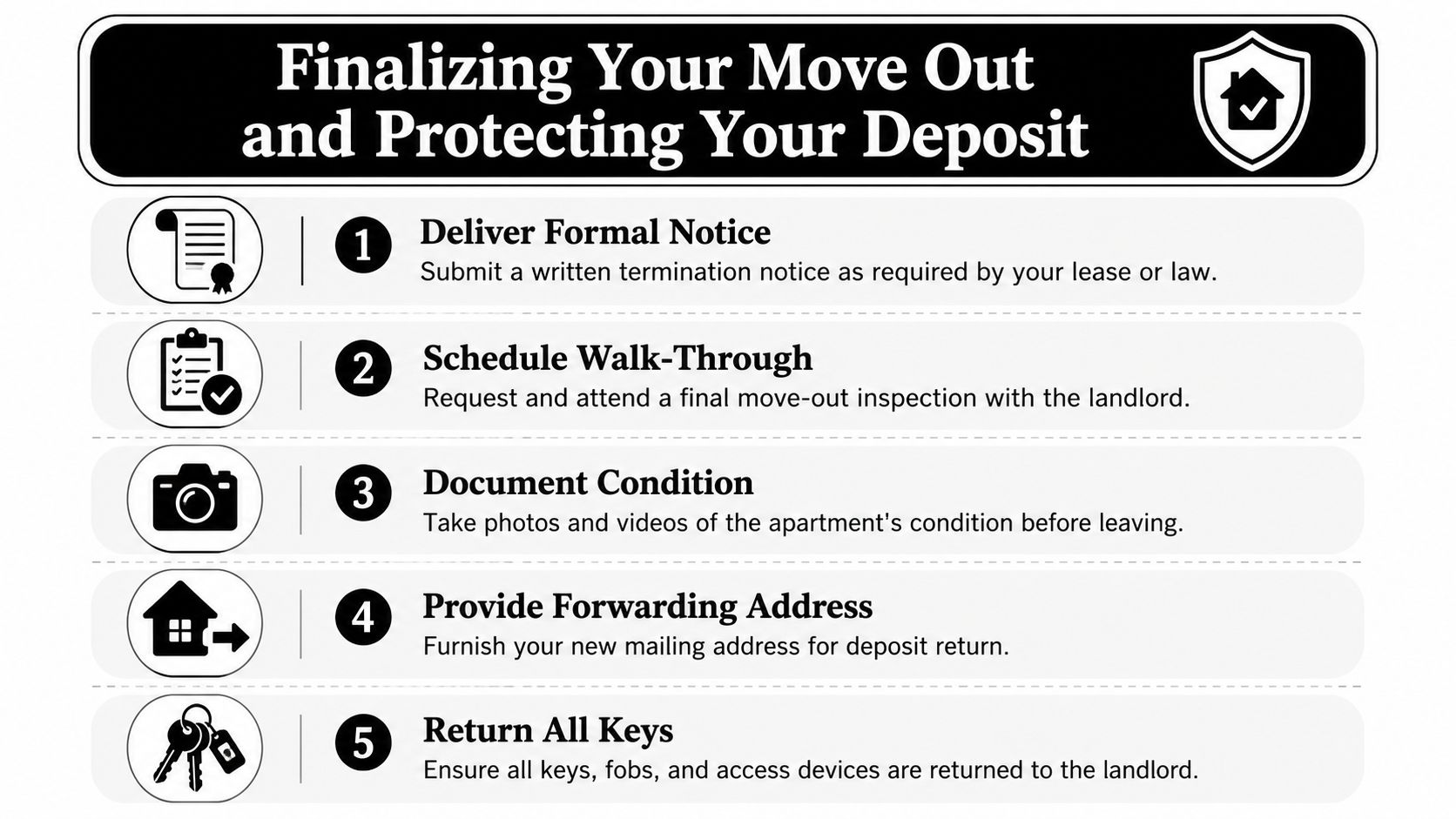
To properly terminate a tenancy in Texas, Texas Property Code §91.001 generally requires a tenant to provide written notice of at least one full rental period, typically 30 days. This notice must be delivered properly, such as via certified mail, to be legally valid, according to this explanation of Texas notice requirements.
A simple notice should include:
- Your name and unit address
- The date of the notice
- The intended move-out date
- A statement that you are terminating or surrendering possession
- Your forwarding address
- Your signature
If the lease names a specific notice address, use it.
Build your move-out evidence file
Before turning over keys, create proof of condition. Take clear photos and video of every room, appliance, floor, wall, window, bathroom fixture, and entry point.
Ask for a walk-through. If the landlord won't do one, document the request and complete your own inspection record. Good records help if a landlord later claims damage that wasn't there or charges for excessive cleaning.
If you need practical help preparing the unit, a move-out checklist from providers offering cleaning solutions for real estate professionals can help you think through floors, appliances, bathrooms, and final presentation in a way that reduces disputes.
Protect the deposit after you leave
Return every key, fob, garage opener, and access device. Do that in a traceable way.
For deposit issues, how to get your security deposit back in Texas is a useful starting point.
Move-out reminder: Tenants lose deposit disputes when they leave weak proof, not just when they leave damage.
If you're trying to learn how to get out of an apartment lease early in Texas, don't treat the move-out as an afterthought. The notice, condition photos, forwarding address, and key return often become the evidence that decides the money fight later.
Answers to Common Questions About Early Lease Termination
Will breaking a lease hurt my credit
It can, but not just because you moved. Credit problems usually grow out of an unpaid balance, collections activity, or a judgment. The bigger immediate risk is often your rental history and the debt claim itself.
Can a landlord charge me for all the rent left on the lease
Not automatically. Whether you owe anything depends on your legal reason for leaving, your lease terms, and whether the landlord re-rents the unit. If you left without a protected reason or agreement, liability may continue for some period, but the landlord's duties still matter.
Can a landlord charge advertising or turnover costs
Maybe, if the lease allows certain charges and they are legally enforceable. This is why the lease audit matters so much. The answer is usually contractual, not something you should guess at from the front desk.
What if I just move out and disappear
That is usually the worst option. It creates a paper trail against you, not for you. The landlord may pursue rent, fees, collection activity, or a lawsuit, and your side of the story becomes harder to prove because you left without documenting anything.
Is email notice enough
Sometimes a lease allows it, but don't assume. If Texas law or your lease requires written notice in a specific form or delivery method, follow that exactly. Certified mail creates a much stronger record.
Do I need a lawyer
Not every lease exit requires one. Some cases are straightforward. But if the issue involves habitability, safety, stalking, a contested balance, or a threatened suit, legal advice can prevent a small problem from becoming a judgment.
A calm review by a Texas landlord tenant lawyer can identify what category your case fits into. Legal termination right, landlord breach, contract buyout, or negotiated exit. That clarity is what most tenants need first.
If you need help with an eviction, lease issue, or rental dispute, contact The Law Office of Bryan Fagan, PLLC for a free consultation today. A short review of your lease, notices, and move-out plan can help you protect your tenant rights, avoid procedural mistakes under the Texas Property Code, and make a cleaner exit.