Texas has no statewide cap on rent increases, so a landlord can raise rent by 5%, 15%, 30%, or more when a lease expires or during a month-to-month tenancy if the required notice rules are followed. That doesn't mean you have no rights. In Texas, a legal dispute often comes down to timing, notice, motive, and documentation.
Getting a rent increase notice can put a household into panic fast. You may be staring at a renewal offer that no longer fits your budget, wondering whether the number is legal, whether you have to accept it, and whether your landlord is doing this because you asked for repairs or pushed back on a problem.
That stress is real. So is the confusion. A lot of articles stop at “Texas has no rent control” and leave tenants there. That's incomplete. The Texas Property Code still matters. Your lease still matters. Written notice still matters. If the increase is retaliatory or discriminatory, that matters a great deal.
For landlords, the trade-off is just as practical. Texas gives broad pricing freedom, but sloppy notice, poor documentation, and bad timing can turn an otherwise lawful rent increase into a dispute that costs more than the increase was worth. Clear process usually works. Surprise and pressure usually don't.
Your Guide to Navigating a Rent Increase in Texas
A common Texas scenario looks like this: your lease is nearing the end, you open an email or letter from management, and the new monthly rent is far higher than you expected. Maybe you were already dealing with repair issues. Maybe you just renewed school enrollment for your kids and can't move easily. Maybe you're a landlord trying to adjust pricing without losing a good tenant or creating a claim.

That moment feels personal, but the first step is to treat it like a legal and financial document. In Texas, the amount itself often isn't the strongest place to challenge a rent hike. The stronger questions are these: Was the notice proper? Did the landlord wait until the lease allowed it? Was the increase tied to a repair request or another protected action? Was the decision applied in a discriminatory way?
What usually helps first
When people ask how much can a landlord raise rent in Texas, they're often really asking a different question: “Do I have any options?” Often, yes. Just not in the form of a simple percentage cap.
A tenant may have room to push back if the increase came too late, came mid-lease without lease authority, followed a repair complaint, or failed to meet newer transparency requirements. A landlord may protect the increase by giving clear written notice, following the lease exactly, and documenting a lawful business reason.
Practical rule: Don't argue about fairness first. Check legality first. Fairness matters in negotiation, but procedure often decides disputes.
What doesn't work well
Some responses create more risk than advantage:
- Ignoring the notice: Silence can box you into a shorter timeline.
- Relying on hallway conversations: Verbal exchanges are hard to prove later.
- Assuming “too high” means illegal: In Texas, that assumption is often wrong.
- Threatening without records: A strong position needs paper, email, text, or lease language behind it.
If you're trying to protect your tenant rights or manage risk as an owner, the calm approach works better. Pull the lease. Save the notice. Put communications in writing. Then evaluate what Texas law says.
Understanding the No Limit Rule on Texas Rent Hikes
A tenant opens a renewal notice and sees the rent jumping by hundreds of dollars. In Texas, the first hard truth is this: state law does not set a general cap on how much a landlord can raise rent at renewal.
That is the rule. It surprises people, and it leaves tenants exposed in a way that feels personal even when the landlord is making a business decision.
Texas also generally blocks local rent control, so cities such as Houston, Dallas, Austin, and San Antonio usually cannot impose their own ordinary rent caps. For most residential tenants, that means there is no statewide percentage limit, no fixed dollar ceiling, and no automatic inflation formula controlling a renewal increase.
What Texas law does regulate is often the part that gives tenants the most practical room to respond. The key questions are whether the increase comes at renewal or during the lease, whether the lease permits the change, whether the landlord gave the right notice required for a Texas rent increase, and whether the increase crosses into retaliation or discrimination.
What the no-limit rule actually allows
A landlord can usually propose a sharp increase when a fixed term ends or when a month-to-month tenancy is renewed with proper notice. Texas law does not require the new rent to track a government formula or stay within a set percentage of the old rent.
That does not mean every increase is safe.
A rent hike that is legal in amount can still fail on timing, lease language, or motive. That is where many disputes are won or lost in practice. I often tell clients to stop arguing about whether the number feels outrageous for a moment and check whether the landlord had the right to impose it on that date, in that way, for that reason.
Fixed-term leases and month-to-month tenancies are not treated the same
The no-cap rule does not give a landlord unlimited freedom to change rent whenever they want.
| Tenancy type | When rent can usually change |
|---|---|
| Fixed-term lease | At the end of the lease term, unless the lease itself allows a change during the term |
| Month-to-month tenancy | After proper notice is given |
Under the Texas Property Code, this distinction is critical because many rent disputes turn on timing rather than the size of the increase. A landlord usually has broad discretion at renewal. That same landlord may have no right to raise rent halfway through a fixed lease unless the written lease clearly permits it.
That is more than a technical point. For a tenant, it can mean the difference between having to decide whether to accept a renewal and being able to insist that the current rent remains in place until the lease ends.
Market rate is a negotiation point, not a legal cap
Landlords often justify increases by citing market rent. Sometimes that is accurate. Sometimes it is aspirational.
If you want a concrete way to test the landlord's number before negotiating, Zillow rental pricing trends can help you compare local asking rents. That will not create a legal limit under Texas law, but it can give a tenant useful ground for a counteroffer, a shorter renewal term, or a request for repairs or concessions in exchange for accepting the increase.
For readers also dealing with payment disputes, Late Fees and Rent Rules in Texas covers what Texas law allows regarding late fees and rent collection. That issue is separate from a rent increase, but the two often appear in the same dispute.
A high renewal offer may be legal. A mid-lease increase without lease authority is a different problem.
The Critical Role of Proper Notice Periods
The strongest day-one question isn't “Is this increase too much?” It's “Was I given proper notice?” In Texas, notice is the procedural backbone of a rent increase.
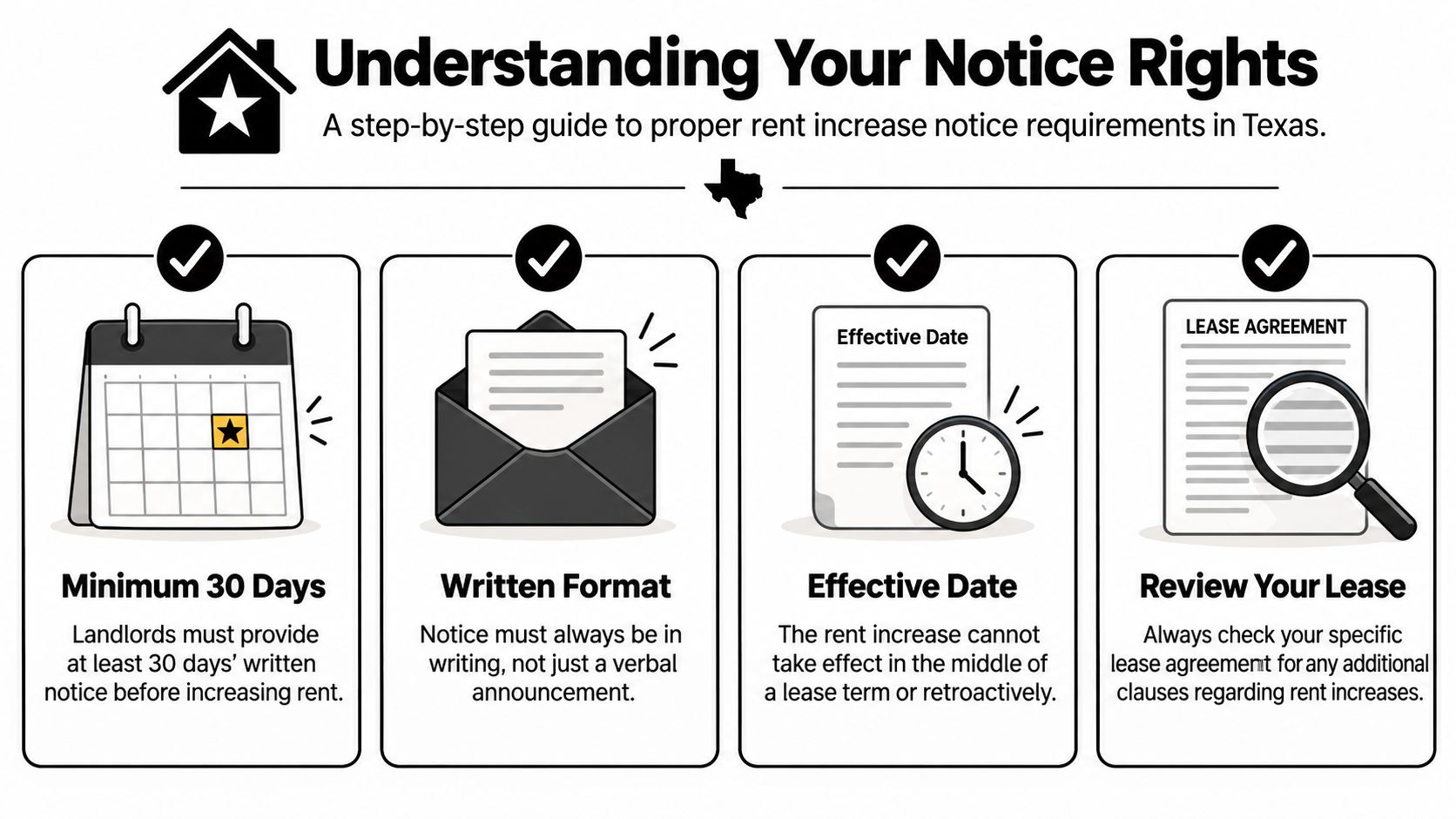
For month-to-month leases, landlords must provide at least 30 days' written notice before increasing rent, and if the increase is more than 10% within a 12-month period, 75 days' notice is required under the rules summarized in this Dallas rent increase guide. For a fixed-term lease, the increase generally can't take effect in the middle of the term unless the lease says it can.
How to check the notice yourself
Use this checklist the same day you receive the notice:
- Identify your tenancy type. Are you month-to-month, or are you still inside a fixed lease term?
- Look for the delivery date. You need the date the notice was provided.
- Find the effective date. This is the date the new rent is supposed to start.
- Measure the gap. For month-to-month tenancies, count whether you received at least the required written notice.
- Check the size of the increase. If it exceeds 10% within a 12-month period, the longer notice rule matters.
If you need a fuller explanation of timing rules, this guide on how much notice a landlord has to give in Texas is a useful starting point.
What valid and invalid notice can look like
A valid notice usually has these features:
- Written form: It's delivered in writing, not just mentioned by phone or in passing.
- Clear effective date: It tells you when the new rent starts.
- Correct timing: It gives enough lead time for the type and size of increase.
- Lease compliance: It doesn't try to override a fixed lease without authority.
An invalid notice often has one of these flaws:
- Verbal only: A manager tells you the rent is going up but never provides written notice.
- Too short: The increase starts before the required notice period has run.
- Mid-term change: The notice tries to raise rent before the lease ends, with no lease clause allowing that.
- Retroactive charge: The landlord tries to collect the increased amount for a period that already passed.
Written notice is not busywork. It gives tenants time to budget, negotiate, or move, and it gives landlords a record that they followed the law.
Why this matters in practice
Notice defects often create an advantage that tenants miss. If a landlord's timing is off, the issue may not erase the increase forever, but it can delay enforcement and give you room to negotiate. For landlords, good notice reduces the chance that a routine renewal turns into a contested dispute with an eviction attorney or a Texas landlord tenant lawyer involved.
When a Rent Increase Becomes Illegal
A rent increase can be lawful in amount and still unlawful in motive. In Texas, the two biggest danger zones are retaliation and discrimination.
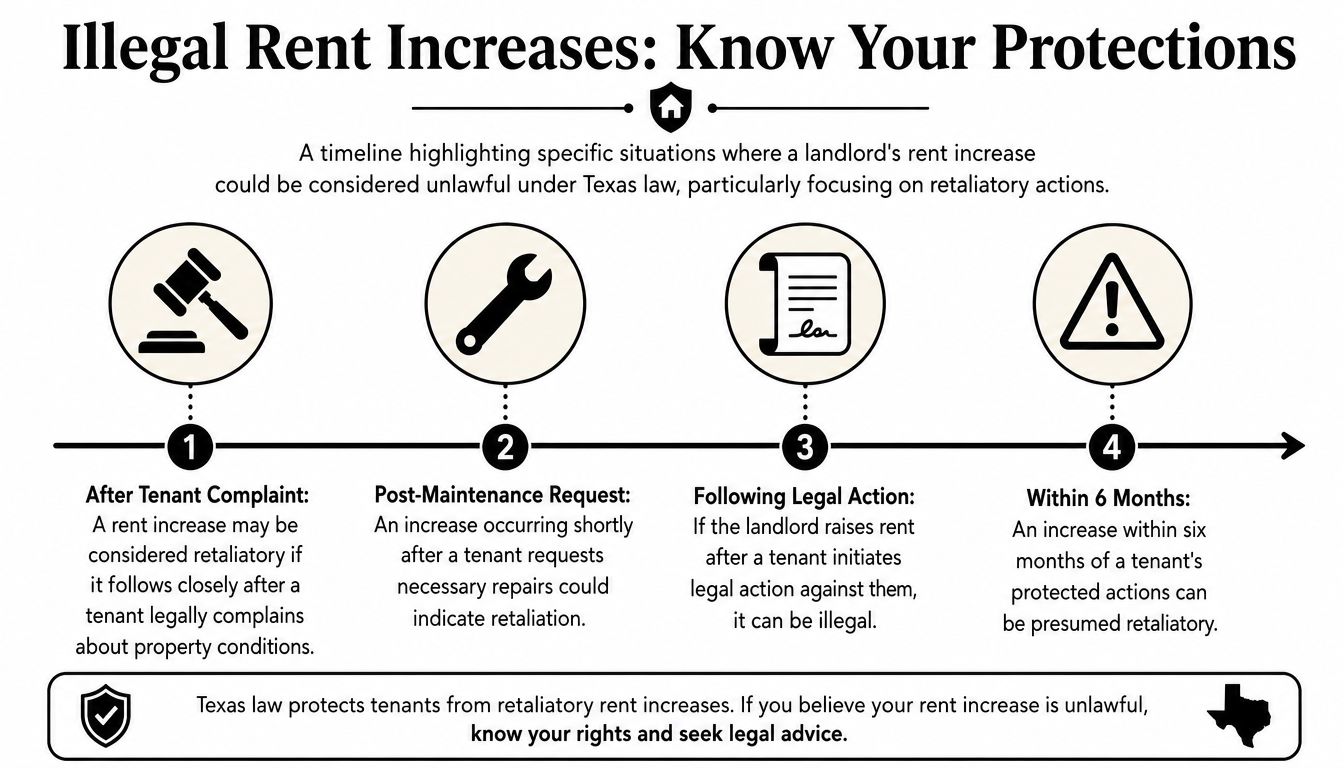
Under Texas Property Code § 92.331, a landlord can't retaliate against a tenant for exercising certain legal rights. The law prohibits retaliatory rent increases within six months of protected actions such as requesting repairs or making a complaint about conditions. Texas guidance also notes that a steep increase, such as 30%+ immediately following a repair request, can be presumptively retaliatory, as discussed in this Texas rent increase discussion.
Retaliation under Texas Property Code
This is the pattern I tell clients to watch closely: a tenant asks for repairs, reports code issues, or otherwise pushes for habitability compliance, and soon after receives a rent increase notice or nonrenewal pressure. The legal issue isn't that the landlord raised rent. It's that the landlord may have raised rent because the tenant asserted a right.
The hard part is proof. Many tenants complain verbally to onsite staff and assume that's enough. Sometimes it may be. But the evidentiary problem is obvious. If the complaint wasn't documented, the landlord may deny it happened or dispute what was said.
That's why written communication matters so much.
- Email the repair request
- Text only if you can preserve screenshots
- Keep photos, dates, and follow-ups
- Save the rent increase notice with the envelope or transmission date
For a closer look at billing-related disputes and what tenants can challenge, see tenant rights for overcharging rent in Texas.
Red flag: If the rent increase lands soon after you asked for necessary repairs, don't treat it as a routine pricing decision until you've looked at retaliation.
Discrimination is a separate issue
A rent increase can also be illegal if it is based on a protected characteristic under the federal Fair Housing Act. That includes discrimination based on race, religion, disability, or familial status. In practice, the issue may appear as different pricing, different renewal terms, or selective enforcement against one tenant group but not another.
Examples of warning signs include:
- Unequal treatment: Similar tenants receive different renewal terms for reasons unrelated to lawful business factors.
- Family-status targeting: A household with children faces harsher renewal treatment because of the children.
- Disability-related pressure: A tenant who requests accommodation is then hit with a rent increase tied to that request.
Remedies can be real
Texas guidance states that tenants facing illegal retaliatory or discriminatory increases may recover a civil penalty of one month's rent plus $500, along with actual damages, court costs, and reasonable attorney's fees under the remedy provisions described in this Texas rent control laws overview.
That doesn't mean every suspicious increase wins in court. It does mean these disputes are not just theoretical. Good documentation can turn a tenant's hunch into a legal claim, and poor documentation can sink a valid complaint.
Using New Transparency Laws to Your Advantage
One of the most useful developments in this area isn't a cap. It's a paper trail requirement.
Under TX HB1185, effective September 1, 2025, landlords must disclose the improvements justifying a rent increase in writing at least seven days before a tenant's move-out notice window, according to the legislative tracking summary for TX HB1185. That doesn't stop all increases. It does create a procedural tool that many renters and smaller landlords still don't know exists.
Why this matters
Most “how much can a landlord raise rent in Texas” articles end with “there's no limit.” That overlooks an important advantage. If a landlord relies on improvements to support the increase, the written disclosure requirement forces clarity. A tenant can ask: What improvements? When were they made? How do they relate to this renewal?
That changes the conversation. Instead of arguing in general terms, you can ask for specifics in writing.
How tenants can use HB1185
If you receive a renewal increase and the landlord points to upgrades or property improvements, respond in writing and keep the tone professional. Ask for the written disclosure and compare it to what was done.
A practical approach looks like this:
- Confirm the timeline: Was the disclosure provided early enough?
- Request detail: What improvements are being used to justify the increase?
- Compare to reality: Were those improvements made to your unit, the common areas, or somewhere else?
- Use the answer in negotiation: If the explanation is thin, you may have room to ask for more time, a lower increase, or different renewal terms.
A transparency rule doesn't cap the price. It gives you a basis to ask better questions and slow down a rushed renewal process.
What landlords should do
Landlords should treat this as a documentation issue, not a technicality. If property improvements are part of the renewal decision, the written explanation needs to be timely and specific. Vague references to “upgrades” often create more conflict than they solve.
This is also where legal review can help. A Texas landlord tenant lawyer can review renewal language, notice practices, and supporting documentation before a dispute escalates. The Law Office of Bryan Fagan, PLLC handles landlord-tenant disputes, lease enforcement, renewal issues, and related Texas Property Code questions for both tenants and landlords across Texas.
Your Action Plan After Receiving a Rent Increase Notice
If you've just received a rent increase notice, don't make the mistake of treating it as final on day one. Start with facts. Then decide whether to negotiate, object, prepare to move, or get legal help.
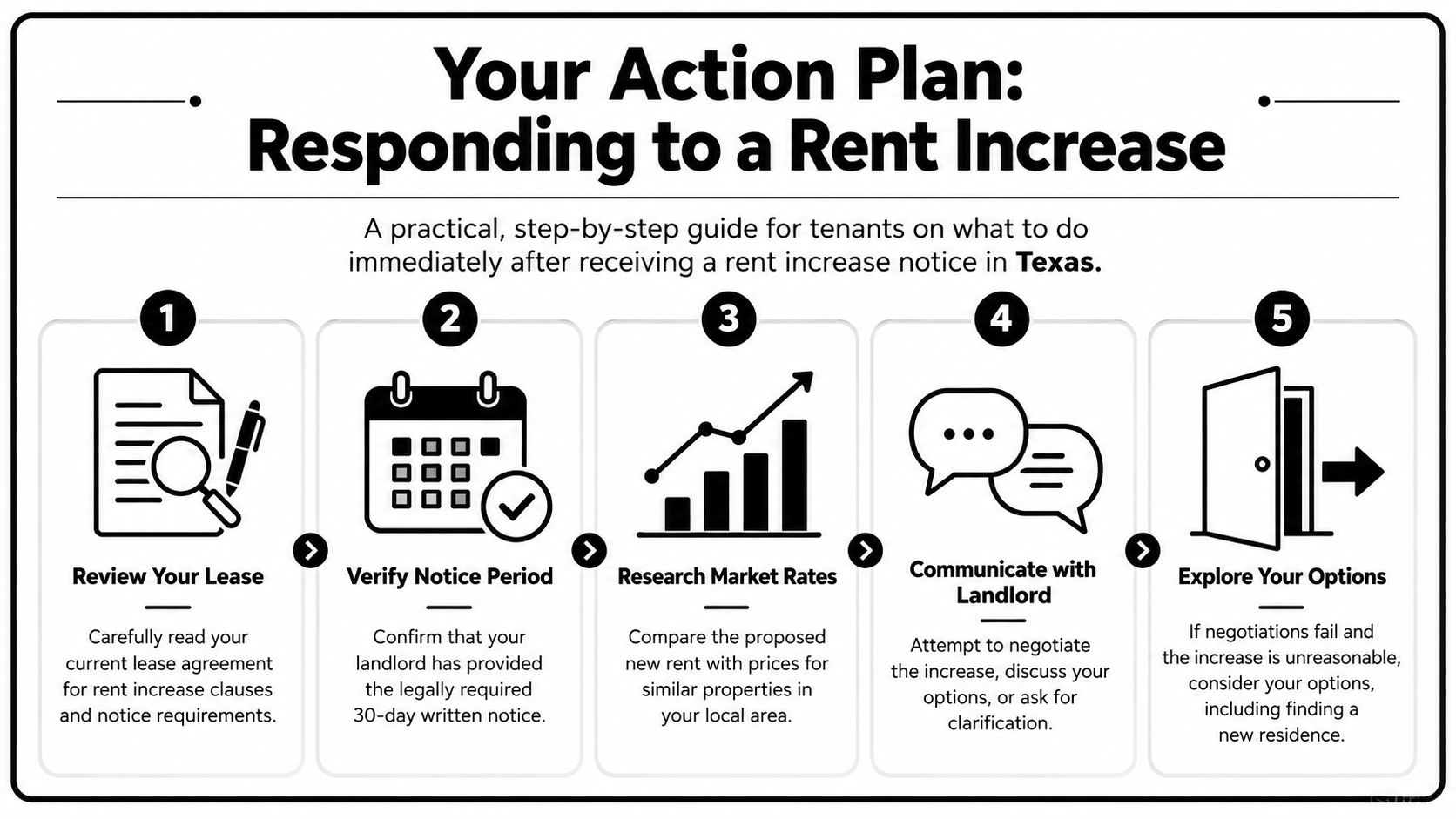
Step one through step three
Review the notice immediately
Check the delivery date, the effective date, and whether the notice is in writing. If you're month-to-month, timing is critical. If you're in a fixed-term lease, check whether the landlord is trying to change rent before the term ends.Read your lease from top to bottom
Don't rely on memory. Look for rent adjustment language, renewal provisions, notice terms, and any clause that allows a mid-term change. In many disputes, the lease answers the first question faster than anything else.Look for retaliation facts
Ask yourself whether you recently requested repairs, complained about conditions, or exercised another legal right. Build a simple timeline with dates, emails, photos, and notices. If the sequence looks suspicious, preserve everything.
Step four and step five
Put your response in writing
Even if you've already spoken with management, send a written response. Keep it calm. Ask for clarification on the effective date, notice basis, and any claimed improvements tied to the increase. If you're negotiating, make a specific proposal rather than just saying the amount is unfair.Negotiate from a documented position
Many disputes don't need a lawsuit. They need a written record and a realistic counteroffer. If you want help structuring that conversation, this guide on how to negotiate a rent increase gives practical next steps.
A simple decision guide
| If this is true | Your next move |
|---|---|
| The notice appears defective | Object in writing and cite the timing or lease issue |
| The increase followed a repair request | Preserve records and assess a retaliation claim |
| The landlord cites improvements | Request the written justification and review the timing |
| The increase is legal but unaffordable | Negotiate, plan a move, or ask for more time |
| The facts are messy or contested | Speak with a Texas landlord tenant lawyer |
Good outcomes usually come from quick, written, organized responses. Delay helps the other side more than it helps you.
What works better than panic
For tenants, the best move is usually disciplined documentation. For landlords, the best move is usually disciplined compliance. Texas law gives landlords room on price, but not a free pass on process. It gives tenants fewer caps than they may want, but more procedural advantage than many realize.
If you're searching for answers about how much can a landlord raise rent in Texas, the honest answer is that the number itself may be unlimited. Your advantage is derived from everything around that number. The lease term. The written notice. The timing. The reason. The record.
That is where many cases are won or lost.
If you need help with an eviction, lease issue, or rental dispute, contact The Law Office of Bryan Fagan, PLLC for a free consultation today. Whether you're a tenant protecting your rights or a landlord trying to comply with the Texas Property Code, clear legal guidance can help you act quickly and avoid costly mistakes.