Dealing with a landlord dispute or eviction can be stressful, especially when a lease ends and nobody clearly explains what happens next. A tenant may believe continued rent payments mean the tenancy continues, while a landlord may believe the tenant has become an unauthorized occupant. In Texas, that difference can determine whether the landlord needs to terminate a periodic tenancy first or can proceed with a forcible detainer action after the required notice.
A holdover tenant in Texas is not automatically the same as a month-to-month tenant. Lease language, rent acceptance, written communications, and the parties' conduct can change the legal relationship. The Texas Property Code provides the framework, but applying it correctly requires careful attention to what happened after the lease expired.
What Happens When a Lease Ends Without Renewal
A one-year lease expires on August 31. On September 1, the tenant is still living in the home. No renewal agreement was signed, the landlord never sent a formal renewal offer, and the tenant assumes everything is fine because rent has always been paid on time.
A few days later, the landlord asks when the tenant plans to leave. The tenant responds that they thought they could keep paying monthly. The landlord says the lease ended and demands possession. Then a rent payment arrives, creating a new question: did the landlord accept money for temporary use of the property, or did the landlord accept rent and create a continuing tenancy?
That confusion is common. No news is not necessarily good news when a fixed-term lease expires. The original lease doesn't vanish. Instead, the parties' rights may depend on the lease's renewal, conversion, and holdover provisions, along with what each person did after the end date.
Why silence creates risk
A landlord who wants possession should communicate clearly before or immediately after expiration. A tenant who needs additional time should request a written extension rather than relying on a past practice of paying rent. A casual text saying “you can stay for now” may later become evidence that the landlord consented to continued occupancy.
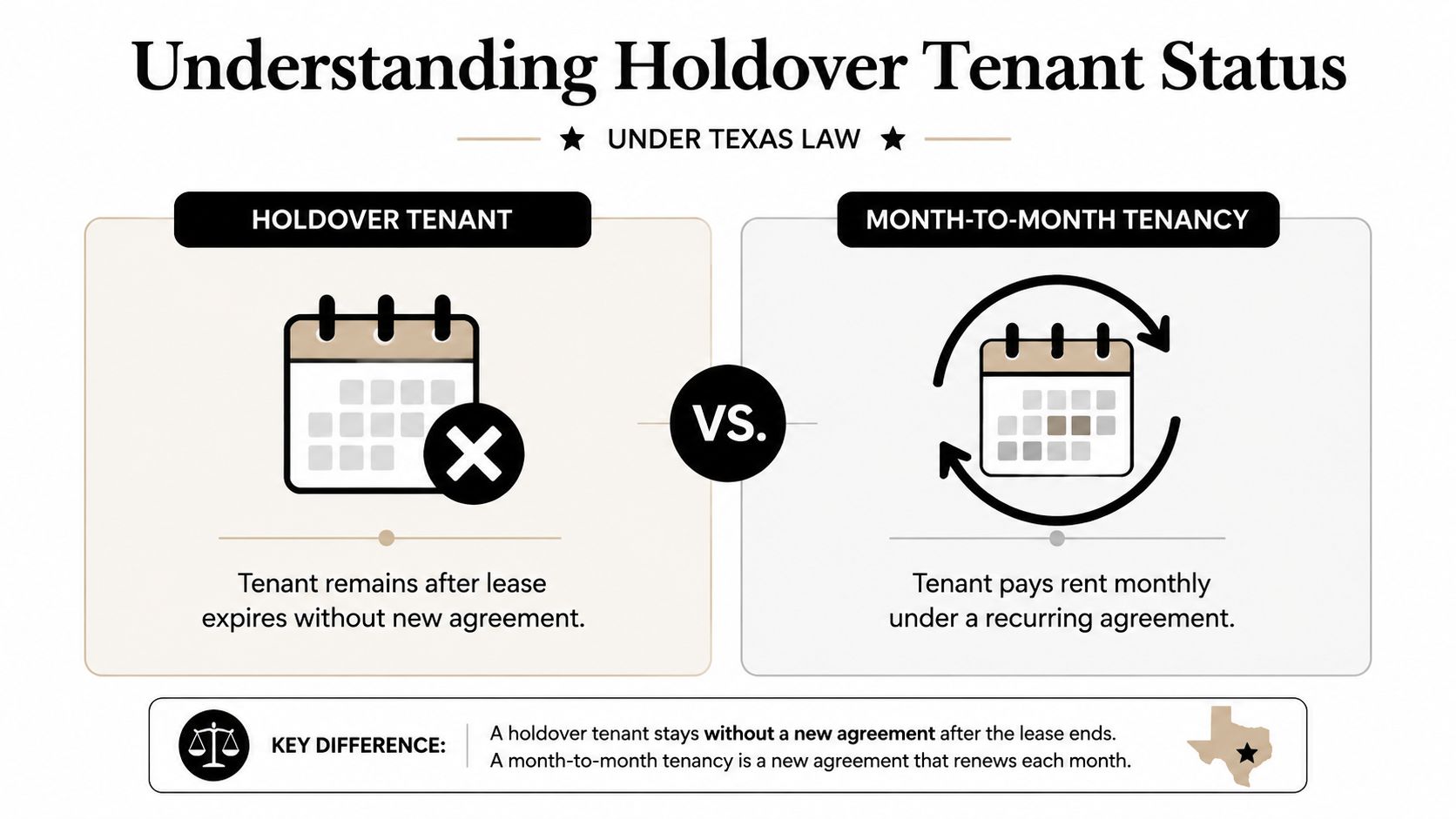
A tenant who remains after the lease ends without the landlord's explicit consent to a new tenancy may be treated as a holdover tenant, sometimes described as a tenant at sufferance. The tenant has possession, but the landlord may dispute the tenant's right to remain. That status is different from a negotiated month-to-month arrangement.
Practical rule: Both sides should put the post-expiration arrangement in writing before money changes hands.
Tenants can review related timing issues in this guide to Texas lease renewal notice requirements, including whether the lease required advance notice or contained an automatic renewal term. Landlords should also inspect the full lease before demanding move-out. A clause that appears routine may control the outcome.
The safest approach is direct communication. The landlord should state whether the tenant may remain temporarily, whether any payment is being accepted for use and occupancy, and the exact move-out date. The tenant should ask for written terms and avoid assuming that depositing rent means the landlord has agreed to a new lease.
Understanding Holdover Tenant Status Under Texas Law
Texas law distinguishes between a tenant who remains after a lease ends without consent and a tenant who has entered a periodic tenancy. That distinction matters because the landlord's notice obligations and the tenant's defenses can change depending on which relationship exists.
Texas Property Code § 24.005 addresses the notice required before a landlord files a forcible detainer suit against a holdover occupant. The Texas State Law Library describes a holdover tenant as an occupant who remains after the lease expires or is terminated, and the landlord generally must provide at least three days' written notice to vacate, unless the lease sets a different period. See the Texas State Law Library's eviction guidance.
Texas Property Code § 91.001 addresses termination of tenancies from month to month and other periodic arrangements. For a month-to-month tenancy, practice commonly requires one full month's written notice to terminate the tenancy itself. That is separate from the statutory notice to vacate that may apply before filing a forcible detainer case.
The facts that usually matter
Courts may examine several parts of the parties' relationship:
- Lease language: The agreement may provide for automatic renewal, conversion to month-to-month status, or a tenancy at sufferance after expiration.
- Rent acceptance: A landlord's acceptance of post-expiration rent can support the tenant's argument that the landlord consented to continued occupancy, depending on the circumstances.
- Written communications: Emails, texts, renewal offers, move-out demands, and payment instructions can show what each party understood.
- Course of dealing: Repeatedly accepting payments without objection may create an argument that the landlord treated the relationship as continuing.
The label alone doesn't decide the case. A landlord may call someone a holdover, but the tenant may have evidence of a renewal or conversion. Likewise, a tenant may claim a month-to-month tenancy even though the lease expressly rejected continued occupancy and the landlord promptly demanded possession.
A holdover occupant can have procedural protections even when the landlord disputes the right to remain. The landlord generally cannot change the locks or remove the tenant without following the court process. Texas eviction law is built around notice, a justice court case, judgment, and enforcement through a writ of possession.
The practical point is simple: a holdover dispute is often decided by conduct after expiration. Casing a rent check, sending an unclear message, or allowing the tenant to remain without a documented reservation of rights may complicate what initially looked like a straightforward eviction.
Notice Requirements Before Filing an Eviction
A landlord generally must serve a written notice to vacate before filing a forcible detainer suit against a holdover tenant. Under Texas Property Code § 24.005, the default is at least three days' written notice, unless the lease or rental agreement sets a different period. If the lease requires five days, that contractual period controls.
The deadline depends on delivery. Texas court guidance states that counting begins on the day the notice is delivered. The landlord should therefore identify the delivery date and preserve proof of service. Potential methods include mail, hand delivery, delivery inside the premises, or electronic communication when the parties agreed in writing to electronic delivery. See the Texas Supreme Court notice guidance.
A workable notice process
A defensible notice should identify the property, state that the lease expired or the tenancy ended, demand possession, and give a clear move-out deadline. For example:
The lease for [property address] expired on [date]. You are required to vacate and surrender possession of the premises no later than [deadline]. If you remain after that deadline, the landlord may file a forcible detainer action seeking possession and any relief allowed by law.
This sample does not replace review of the lease and the facts. The required period, wording, and delivery method must match the tenancy. Lease language may reject continued occupancy, create a holdover term, or address whether accepting rent creates a periodic tenancy. That distinction matters because a tenant's status can change after expiration, particularly if the landlord accepts rent without clearly reserving rights.
The Texas Notice to Vacate: Requirements and Timing guide explains what a valid Texas Notice to Vacate should contain. A verbal demand usually does not create the clear record a court needs. An informal text message may also be inadequate unless electronic delivery was agreed to in writing and the message satisfies the applicable requirements. For a broader explanation, review the Texas Notice to Vacate: Requirements and Timing guide.
Notice documentation checklist
- Confirm the lease term: Check the expiration date and every renewal or holdover provision.
- Calculate the deadline: Count from actual delivery and apply the lease's notice period if it differs from the statutory default.
- Keep the signed notice: Save the exact document served, not a later reconstruction.
- Record delivery details: Note the date, time, location, method, and person who delivered it.
- Preserve proof: Keep mailing records, delivery confirmations, photographs, and related evidence.
- Document rent communications: Keep payment instructions, receipts, and any statement reserving the landlord's rights.
- Wait before filing: Filing before the notice period ends can result in dismissal and require the process to begin again.
A defective notice can cost the landlord time and additional filing or service fees. A tenant who receives one should compare it with the lease and preserve the envelope, attachments, payment records, and delivery information.
The Eviction Timeline for Holdover Tenants
A Texas holdover eviction proceeds through the justice court rather than through immediate self-help removal. After the notice period expires, the landlord files a forcible detainer case in the justice court precinct where the property is located. The tenant must then receive citation and an opportunity to respond and appear.
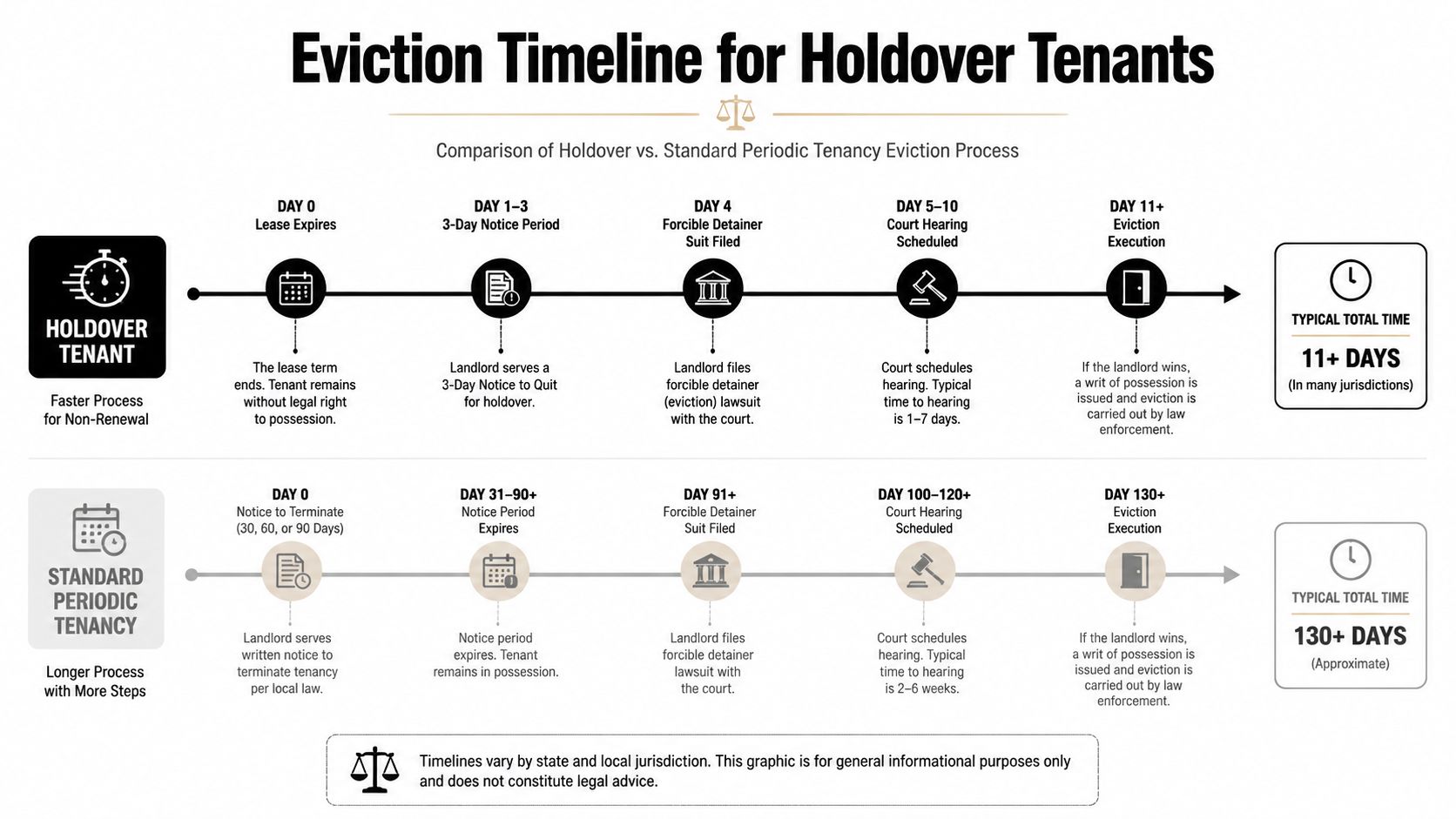
A typical uncontested holdover case may move from notice to writ of possession in roughly 21 to 35 days, although contested cases and local court conditions can take longer. Trial is commonly set 10 to 21 days after filing, and a six-day waiting period after judgment generally applies before a writ can issue. These timing points are described in the Texas holdover process overview from a Dallas landlord-tenant practice source: Texas holdover eviction timing.
A practical sequence
Notice period: The landlord delivers the notice and waits until the stated deadline passes. Filing too early can lead to dismissal.
Justice court filing: The landlord files the forcible detainer petition and pays the required court costs. The petition should accurately identify the lease expiration, notice, and basis for possession.
Citation and hearing: The tenant receives citation and hearing information. The hearing date depends on the court's docket and service timing, but holdover hearings are commonly set within the period described above.
Judgment and enforcement: If the landlord proves the right to possession, the court may enter judgment. The writ stage follows the applicable waiting period and gives the constable authority to enforce possession.
Court backlogs, service problems, holidays, appeals, and factual disputes can extend the process. The case may also become less predictable if the tenant claims a renewal, points to accepted rent, or argues that the notice did not comply with the lease.
For a broader explanation of the process, see how long an eviction takes in Texas. Tenants shouldn't ignore citation papers just because they believe the landlord is wrong. Landlords shouldn't assume a clear expiration date eliminates the need to prove notice and proper service.
The most efficient cases are usually the ones with a clear lease, a valid notice, reliable service evidence, and consistent conduct by both parties. A rushed filing without those pieces often creates delay rather than speed.
How Rent Acceptance and Lease Language Change Outcomes
Rent acceptance is one of the most important practical issues in a holdover dispute. A landlord may intend to accept money only for the tenant's use of the property while pursuing possession, but an unconditional acceptance of rent can support the tenant's argument that the landlord agreed to continued occupancy.
That doesn't mean every payment automatically creates a month-to-month tenancy. The surrounding facts matter. The lease may contain a holdover provision, the landlord may reject payment, or the landlord may clearly state in writing that any accepted funds are for use and occupancy and don't waive the right to seek possession.
Read the lease before processing payment
A lease may provide that the tenant becomes month to month, remains a tenant at sufferance, or owes a specified holdover charge after expiration. In commercial settings, a lease may authorize holdover rent higher than the original amount if the provision is properly documented. Residential disputes often focus more heavily on possession, notice, renewal language, rent acceptance, and whether the parties created a new arrangement.
The enforceability of a holdover-rent clause depends on the wording and circumstances. A charge intended to account for actual disruption may receive different treatment from a provision that functions as an unsupported penalty. Landlords shouldn't assume that inserting a large multiplier guarantees recovery, and tenants shouldn't assume that every holdover charge is automatically invalid.
Payment records often tell the story. A rent ledger showing regular monthly charges, ordinary rent receipts, and no objection can support a tenant's position. A landlord's written reservation of rights, separate accounting, and prompt notice can support the opposite position.
For drafting context, What a Texas Lease Should Include identifies key terms and required disclosures in a Texas residential lease. A clear agreement should explain renewal, termination, post-expiration possession, payment treatment, and any holdover obligations.
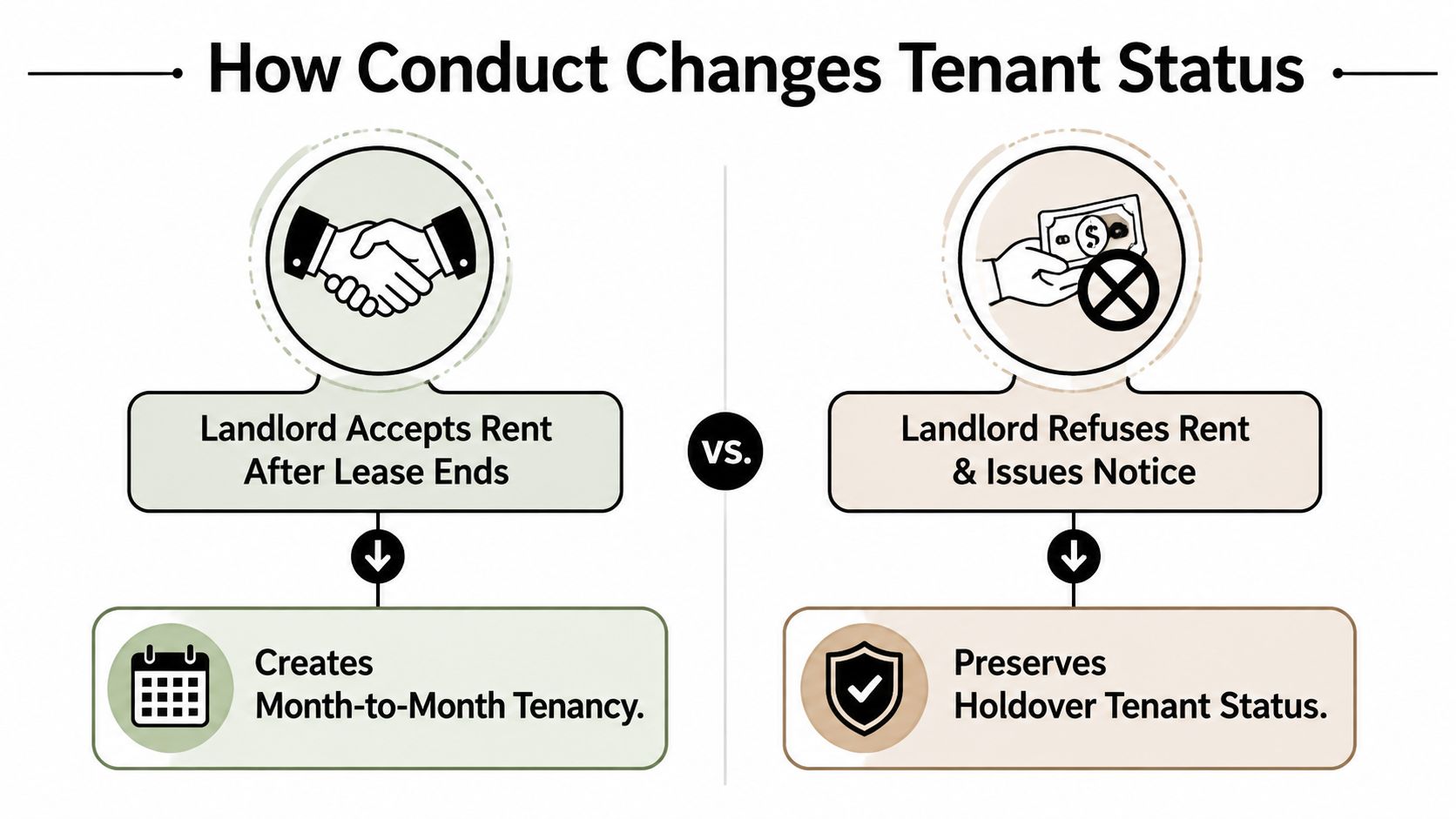
Landlords accepting post-expiration funds should use consistent written language and avoid describing the payment as ordinary monthly rent if they're preserving a holdover position. Tenants should save payment confirmations and communications suggesting the landlord approved continued occupancy. Neither side should rely on informal assumptions when the legal consequence may be a different notice requirement or a contested eviction.
Defenses and Practical Steps for Both Parties
A tenant facing a holdover eviction should focus on defenses supported by documents and facts, not every possible argument. The strongest issue may be that the landlord served the wrong notice, used an unauthorized delivery method, or filed before the contractual deadline expired.
Other potential issues include a landlord's acceptance of rent, evidence of a renewal or extension, or a claim that the eviction was retaliatory under Texas Property Code § 92.331. A tenant may also raise serious property-condition issues, but those issues don't automatically defeat a possession case. The tenant should connect the defense to specific facts, written complaints, repair records, photographs, or witness testimony.
What landlords should do
- Create a paper trail: Keep notices, emails, texts, payment records, and inspection notes together.
- Review every clause: Confirm whether the lease renewed, converted, or created a tenancy at sufferance.
- Control payment descriptions: Don't accept partial or post-expiration payments without a written agreement explaining their purpose.
- Avoid self-help: Don't change locks, shut off utilities, or remove belongings outside lawful procedures.
Landlords also face broader risks when managing property and occupants. A practical property owner liability guide can help identify operational concerns that extend beyond the immediate possession dispute.
What tenants should do
Respond to the citation, collect the signed lease and payment history, and write down the timeline while events are fresh. A tenant who needs more time may have better results negotiating a written move-out agreement than waiting for the hearing and hoping the court grants additional time.
Settlement terms should identify the move-out date, payment obligations, property condition, keys, personal property, and what happens if either side fails to comply. A written agreement can give both parties more control than a rushed courtroom decision, while the tenant should understand that unresolved eviction litigation can affect future rental applications.
When to Contact a Texas Landlord-Tenant Attorney
DIY action becomes risky when the facts are disputed or the lease contains more than a simple expiration date. A landlord should consult a Texas landlord tenant lawyer before filing when the tenant claims an automatic renewal, alleges retaliation or discrimination, raises repair or habitability issues, or lives in a property connected to federal housing assistance or subsidized tenancy rules.
A tenant should seek advice when the landlord accepted rent after expiration, never served a proper notice, promised an extension, or demanded a move-out after repair complaints. Those facts may affect whether the tenant is a holdover, a month-to-month tenant, or someone protected by additional legal rules.
Bring practical records to the consultation:
- The complete lease and amendments.
- Every notice, envelope, email, and text.
- Rent receipts, bank records, and ledger entries.
- Repair requests, photographs, and inspection documents.
- A timeline showing what happened before and after expiration.
Texas justice courts move quickly. Waiting until the hearing date can limit the time available to investigate notice defects, prepare defenses, negotiate, or protect appeal rights. The State Bar of Texas referral service and local legal aid organizations may also help tenants who qualify based on income.
The Law Office of Bryan Fagan, PLLC can review lease language, notice procedure, rent acceptance, eviction claims, repairs, and related landlord-tenant disputes. If you need an eviction attorney or help protecting your tenant rights under the Texas Property Code, visit The Law Office of Bryan Fagan, PLLC to schedule a free consultation and discuss a practical strategy for your situation.