
Most Houston eviction cases are decided in justice court within 10 to 21 days of filing, which is exactly why early legal guidance matters. Texas law usually starts with at least a 3-day written notice to vacate, unless the lease provides a different period.
You may be a tenant in Greenspoint who has just received a three-day demand, or a landlord in the Heights trying to regain possession after repeated missed payments. Either way, the first question isn't whether rent is owed. The questions are whether the notice was valid, whether it was served correctly, whether the court has authority over the case, and what evidence is ready before the hearing.
Houston's eviction market adds pressure. The Eviction Lab's Houston eviction tracking data records 78,853 eviction filings over the past 12 months. Earlier reporting based on Harris County Justice of the Peace Court data found more than 76,500 filings in 2023 and 225,994 filings since the start of 2020. In a high-volume system, a missed deadline or incomplete document can change the outcome quickly.
Every case has two tracks. The first is the notice track, which determines whether the landlord gave the tenant the required opportunity to leave or cure the problem. The second is the court track, which begins when the landlord files a forcible detainer action and continues through service, hearing, judgment, appeal, and possible possession.
Facing an Eviction in Houston and Not Sure What Comes Next
A tenant in Greenspoint receives a notice taped to the door after falling behind on rent. The notice gives three days to leave. The tenant believes a payment was made through an online portal, but the landlord's ledger doesn't show it. At the same time, the tenant has text messages about a leaking ceiling that was never repaired.
That tenant shouldn't ignore the notice, but leaving immediately may not be the only option. The tenant needs to preserve payment confirmations, read the lease, document the repair condition, and determine whether the landlord can legally file yet. A Texas landlord tenant lawyer can often identify a notice or documentation issue before the case reaches the justice court.
A landlord may face the opposite problem. A resident in the Heights has stopped paying, the lease has expired, and the property owner needs the unit back. Filing quickly may seem sensible, but filing before the notice period expires, using the wrong address, or failing to prove service can lead to delay and added expense.
Practical rule: A notice to vacate isn't the judgment. It starts a legal clock, and the details of that clock matter.
The Eviction Lab Houston data shows why Houston eviction representation affects both sides. Repeated, high-frequency filings place landlords under pressure to move efficiently, while tenants may need immediate help raising defenses such as improper notice or payment disputes. Houston isn't one uniform rental market either. Recent Houston-area reporting found eviction filings clustered sharply by neighborhood, with some areas carrying far more filing pressure than others. The Houston-area eviction filing analysis reported about 76,300 legal eviction notices in Harris County in 2024, an average of one filing per 10 households, and some neighborhoods exceeding one filing per five rental households.
The Texas Property Code controls the notice, the lawsuit, and many defenses. Harris County JP court procedures control how quickly the case moves in practice. Those rules are the foundation for every decision that follows.
How Texas Property Code Shapes Houston Evictions
Texas Property Code Chapter 24 supplies the basic possession procedure. A landlord generally files a forcible detainer action in the justice court serving the precinct where the property sits. The landlord must first give written notice to vacate unless the lease lawfully establishes another requirement. Section 24.005 is the key starting point for nonpayment and holdover cases.
The default notice period is at least three days, but the lease may provide a shorter or longer period. The notice should identify the reason for termination and give the tenant the deadline stated by law or contract. The landlord must also be able to show that the notice was delivered using a legally recognized method.
Notice timing: Texas law generally requires at least 3 days' written notice to vacate before filing, unless the lease sets a different period. Texas Property Code Section 24.005 governs the statutory framework.
A month-to-month tenancy can create a different termination question. If the parties have an implied or oral month-to-month arrangement, the facts and agreement may require a longer termination notice than a nonpayment demand. The lease should be reviewed before anyone assumes a particular notice period applies.
| Reason for Eviction | Statutory Notice Period | Governing Section |
|---|---|---|
| Nonpayment or lease violation | At least 3 days by default, unless the lease provides another period | Texas Property Code §24.005 |
| Holdover after a tenancy ends | Depends on the lease and the applicable tenancy rules | Texas Property Code §24.005 |
| Month-to-month termination | Depends on the agreement and applicable notice rules | Lease terms and Texas law |
| Attorney's fees demand | Written demand, with the tenant given until the 11th day after receipt before fees may be claimed in many cases | Texas Property Code §24.005 |
Attorney's fees require separate attention. Texas law gives landlords a path to recover fees in many cases only after a written demand to vacate is sent and the tenant is given until the 11th day after receipt before fees may be claimed if suit is filed. Possession and money damages aren't the same issue, so a landlord should make the demand and pleadings match the relief being sought.
For residential repairs, Chapter 92 creates a separate evidence-heavy process. The tenant generally must be current on rent, notify the landlord of a condition that materially affects health or safety, and allow a reasonable time for a diligent repair effort. The Texas State Law Library repair guidance explains that a reasonable time is generally 7 days, although severity and repair availability can change the analysis. Possible remedies include court-ordered repairs, repair-and-deduct under Section 92.0561, or lease termination under Section 92.056(e).
Readers who need a plain-language overview of how a forcible detainer proceeds under Chapter 24 can review The Texas Eviction Process Explained. In a Houston case, the statute dictates the deadlines, while the Harris County JP court docket determines how those deadlines play out on the ground.
The Houston Eviction Timeline From Notice to Possession
The process begins before a lawsuit. The landlord serves the written notice to vacate and waits through the applicable deadline. Under the default rule in Section 24.005, that period is at least 3 days, unless the lease changes it. A tenant who receives notice should immediately check the service date, lease language, rent records, and stated reason for termination.
After the deadline expires, the landlord files a forcible detainer action in the Harris County justice court precinct where the property is located. The court issues citation, and the tenant must receive proper service. Filing isn't the same as winning. The landlord still has to prove the right to possession, and the tenant still has the opportunity to appear and present defenses.
The Texas eviction timeline guidance describes the hearing as typically set 10 to 21 days after filing. That range makes the case highly practical. A tenant who waits until the hearing may have little time to locate payment records or repair evidence. A landlord who files without organized records may discover the problem only after the hearing date arrives.
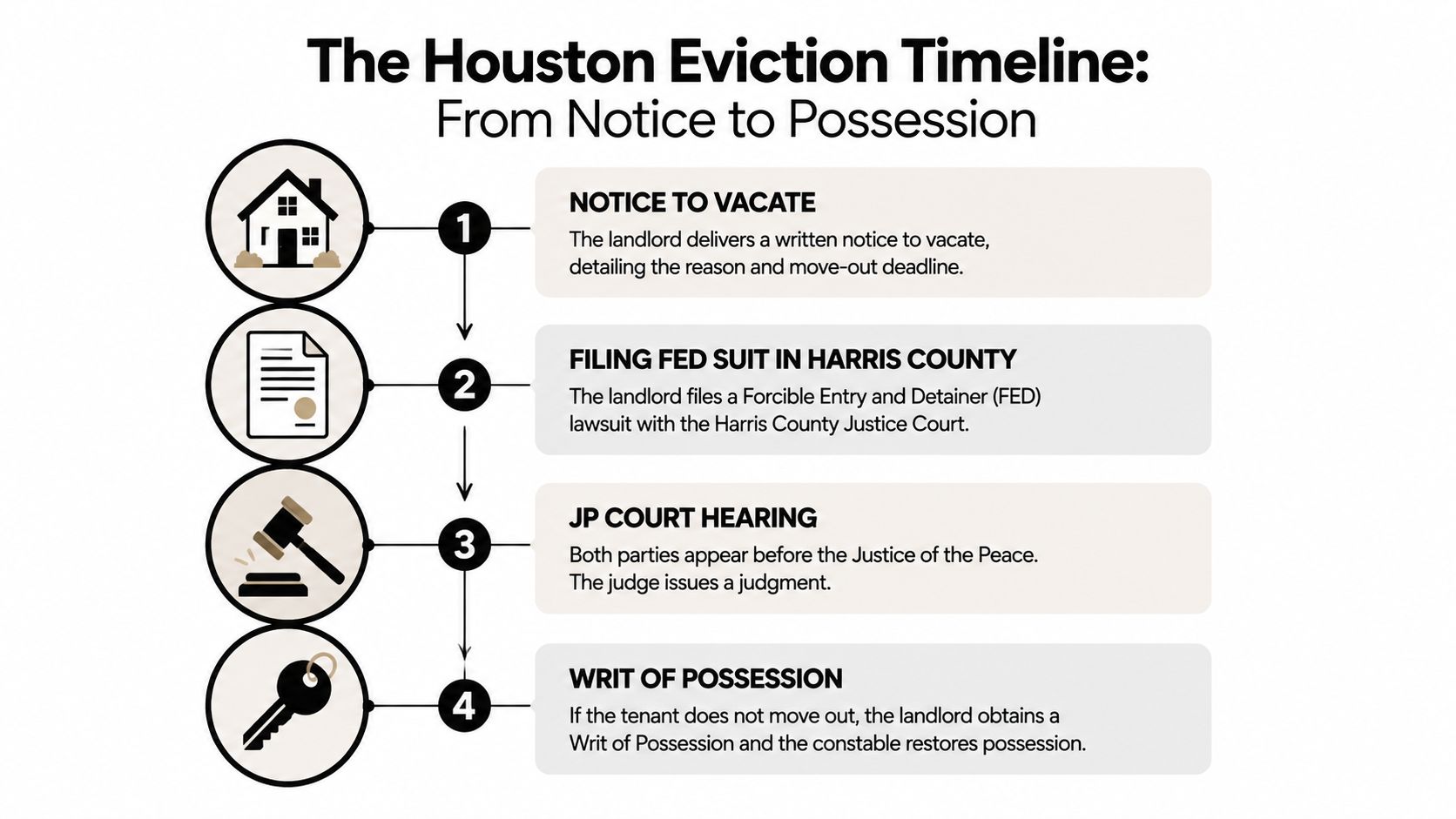
At the hearing, the justice of the peace considers possession evidence. The answer date, appearance, and hearing itself are major points. The tenant should bring the lease, payment proof, notices, photographs, messages, and witnesses who can explain the dispute. The landlord should bring the lease, account ledger, notice, proof of delivery, and records showing the alleged violation.
If the landlord wins, the judgment may lead to a writ of possession. The constable, not the landlord, carries out the lawful lockout process. The parties may also have a 5-day period to appeal or seek other relief, depending on the judgment and case posture. The exact calculation should be confirmed from the court's judgment because a missed appeal deadline can eliminate an important option.
For a separate explanation of timing, see how long eviction takes in Texas. The key lesson is simple: each stage creates a decision point, not just a date on a calendar.
Tenant and Landlord Perspectives in a Houston Eviction Case
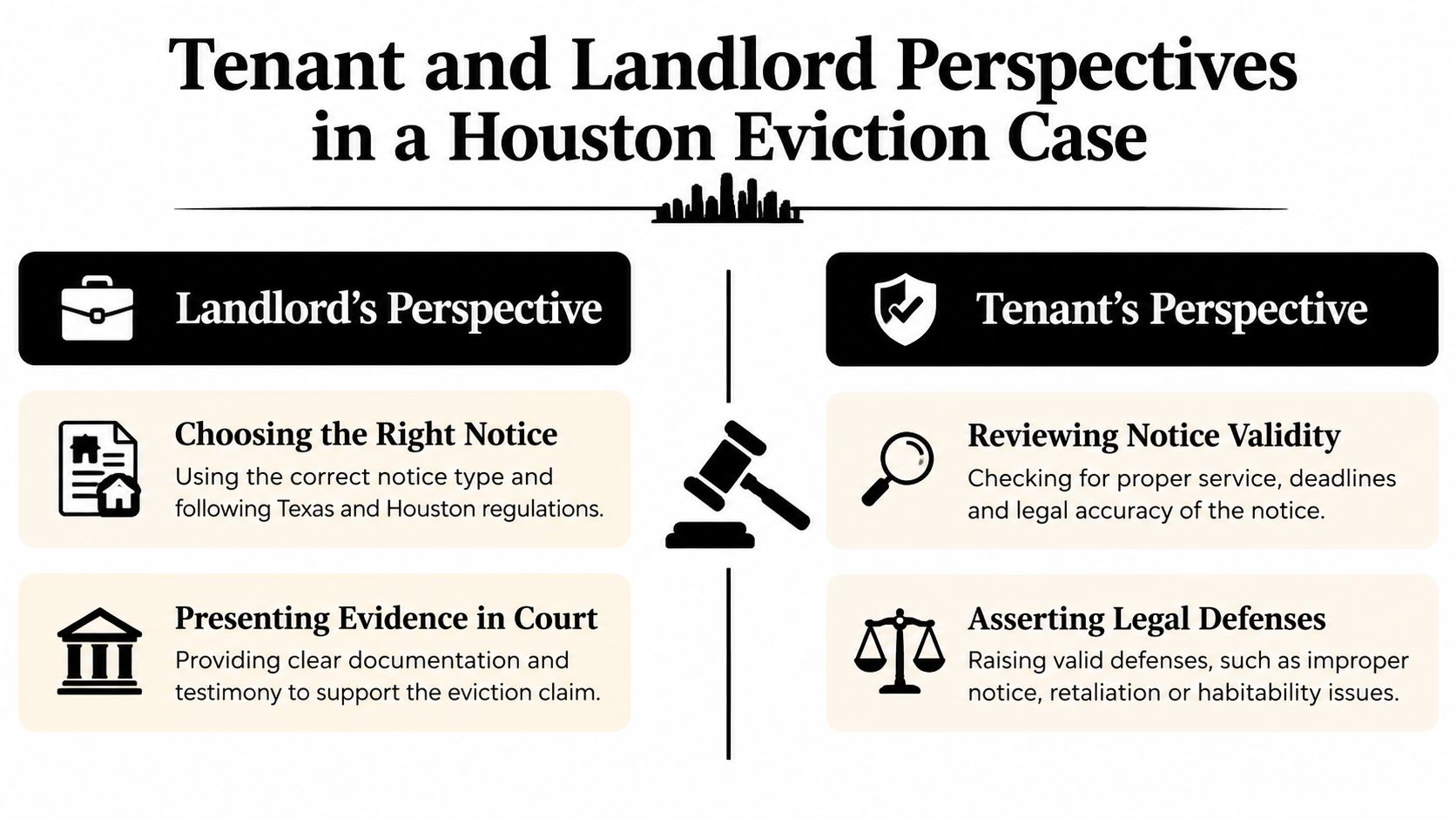
The same Harris County justice court case creates different pressures for each side. A landlord may be carrying an occupied property, unpaid rent, and costs that grow while possession is delayed. A tenant may be trying to protect housing while checking whether the ledger, notice, or service record is accurate. Houston's filing volume and court speed affect both sides. A fast-moving docket can shorten the time available to correct a mistake, gather evidence, or negotiate a move-out agreement.
The landlord's strategic choices
A landlord must identify the correct legal ground and make the notice match the lease and the facts. An incomplete rent ledger can weaken a nonpayment case. A holdover filing can face problems if the lease renewed automatically or required a different termination procedure.
The landlord also chooses whether to seek possession alone or request a money judgment. A money claim may create another path to recovery, but it requires proof of the balance, charges, and accounting. A settlement may make sense if the tenant can pay, leave by an agreed date, or return the property in acceptable condition. Filing quickly may preserve momentum in a busy Houston docket, while a defective filing can lead to a continuance or dismissal and add fees.
The tenant's usable defenses
A tenant should examine notice defects, payment disputes, improper service, and evidence that the landlord accepted rent after claiming the tenancy ended. Chapter 92 may matter when the tenant reported serious repair concerns or believes the eviction followed a protected complaint. Texas Property Code Section 92.331 addresses retaliation, but the defense depends on the timing, proof, and surrounding facts.
Repair-and-deduct disputes require careful review. A repair complaint does not automatically permit the tenant to stop paying rent or defeat possession. The tenant's rent status, notice history, severity of the defect, opportunity given for repairs, and receipts can all affect the result. A tenant seeking a jury trial should request it promptly and understand that the request can add time and cost. It is not a guaranteed way to defeat the case.
Harris County provides docket services and downloadable information through its Justice of the Peace court services. Reviewing local court activity can give parties a better sense of filing conditions than relying only on general Texas descriptions. Tenants addressing the legal case may also consult the Kindness Community Foundation housing guide for housing navigation and advocacy information.
Litigation imposes costs on both sides. Landlords may pay for filing, service, enforcement, and additional delay. Tenants face relocation pressure, a possible judgment, and a case record. Settlement is not appropriate in every dispute, but Houston's local docket conditions make an early evaluation practical, before a hearing leaves fewer choices.
Real Houston Scenarios and the Defenses That Worked
Consider a small landlord near the Heights whose tenant lost a job and stopped paying. The landlord served a nonpayment notice and filed after the deadline. The tenant arrived with a payment confirmation showing a partial rent payment had been deposited into the court registry, along with photographs and repair messages concerning a persistent ceiling leak.

The partial payment didn't automatically erase the case. It did, however, force a closer review of the ledger and the landlord's position on possession. The repair evidence also created a potential habitability dispute. The practical result was a negotiation over payment, a move-out date, and how the documented repair condition would affect the parties' claims. The landlord avoided relying on an unclear account statement, while the tenant avoided assuming that a repair complaint alone would guarantee a dismissal.
A different dispute arose in a Memorial-area duplex. The landlord served a no-fault termination notice after the tenant had recently requested repairs in writing. The tenant gathered the repair request, follow-up messages, photographs, and proof of when the notice arrived. The tenant then raised a retaliation theory under Chapter 92 and requested additional time to present the evidence.
The court's response depended on the pleadings and proof, not merely on the tenant's belief that the timing was unfair. A continuance and a modest monetary remedy became possible because the tenant documented the sequence instead of relying on a verbal account. The landlord then had to weigh the cost of continuing against a structured settlement.
Before the hearing, each side had a practical choice. The landlord could make a written settlement offer with a clear possession date. The tenant could propose payment, a repair plan, or an agreed move-out arrangement while preserving documented claims. A careful review of Texas eviction court defenses that can work can help identify which arguments are legally relevant and which ones are unlikely to change possession.
The accompanying video provides another way to understand the courtroom process.
These examples aren't promises of a particular result. They show why an eviction attorney examines the documents, dates, and conduct of both parties before choosing between settlement and litigation.
What Hiring an Eviction Lawyer in Houston TX Really Costs
Legal fees depend on the type of case, the lawyer's scope of work, and how much opposition the case generates. A simple filing with no meaningful defense is different from a contested matter involving repairs, retaliation, a jury request, a money judgment, or a writ of possession.
No verified fee schedule establishes reliable Houston market figures for the ranges described in many online articles, so a lawyer should quote the actual matter after reviewing the facts. Ask whether the quoted amount covers drafting, filing, service coordination, the hearing, settlement work, appeal issues, or enforcement. A low initial quote may cover only the first filing and not the work that follows.
| Fee Structure | Typical Houston Range | Best For |
|---|---|---|
| Flat fee | Depends on the scope and case complexity | An uncontested residential filing with clearly defined services |
| Hourly representation | Depends on the lawyer's rate and time required | Defended cases, hearings, discovery, and complicated disputes |
| Limited-scope representation | Depends on the specific task | A client who needs document review, coaching, or hearing preparation |
| Hybrid arrangement | Combines a defined fee with hourly or additional services | Cases that may begin simply but could become contested |
The largest cost drivers are usually practical. They include the number of units, whether the client wants possession only or a full monetary judgment, the number and quality of tenant defenses, the likelihood of a jury demand, and whether a writ of possession becomes necessary. Filing fees, service of process, and constable fees may also be separate.
For a tenant, hiring counsel may focus on reviewing notice validity, preparing defenses, negotiating time to move, or asserting repair and retaliation claims. For a landlord, counsel may prevent a premature filing, organize proof, and clarify whether settlement is more efficient than pursuing every available remedy.
A free consultation is the safest way to turn a general fee question into a case-specific plan. The comparison isn't only lawyer cost versus no lawyer cost. It's the quoted legal fee versus the hidden cost of a dismissed case, another filing, lost rent, a missed defense, or an avoidable judgment.
Smart Next Steps and Your Free Consultation
Houston's filing volume and fast Harris County JP calendars leave little room for disorganized preparation. The Eviction Lab's Houston tracking page records 78,853 filings over the past 12 months, while Texas guidance places many hearings within 10 to 21 days after filing. Those conditions make early document review more valuable than last-minute courtroom improvisation.
If you're a landlord
- Confirm the legal ground: Match the lease violation, nonpayment issue, or holdover facts to the notice and requested relief.
- Build the proof file: Gather the lease, rent ledger, notices, delivery evidence, inspection records, photographs, and communications.
- Choose a realistic outcome: Decide whether the priority is possession, payment, a move-out agreement, or a combination that can be proved in court.
If you're a tenant
- Check every date: Compare the notice date, delivery method, lease deadline, payment date, and citation date.
- Preserve evidence: Save rent receipts, bank records, repair requests, photos, videos, texts, emails, and names of witnesses.
- Don't miss the hearing: If you can't attend or need an accommodation, address that issue with the court promptly. Ignoring the case can surrender important defenses.
A consultation should include the lease or any proof of an oral agreement, the notice to vacate, court papers, payment records, repair documentation, photographs, and relevant messages. The Law Office of Bryan Fagan, PLLC offers a free 30-minute consultation to evaluate the situation, explain rights, and discuss a practical strategy. You can also review the firm's Texas rental lawyer information for related landlord-tenant disputes.
The purpose of early advice isn't to guarantee a win. It is to determine whether the facts support settlement, a defense, a corrected filing, or immediate action to protect possession and property rights.
Houston Eviction Questions Worth Asking Early
Can I appeal a Harris County JP eviction judgment?
An appeal may be available, but the deadline and required bond depend on the judgment and the relief requested. Review the written judgment immediately and ask about the supersedeas bond. That bond can determine whether the judgment is paused while the appeal proceeds. Landlords should also account for delayed possession and added procedural work.
Can a landlord refile after dismissal?
Sometimes. A dismissal does not automatically correct the underlying problem. If the first case failed because the notice was defective, service failed, or the evidence was incomplete, the landlord should fix that issue before filing again. The tenant should keep the dismissal order and determine whether the new case concerns a different event or repeats the same defect.
Can a tenant stay and pay through settlement?
The parties may negotiate terms covering payment, possession, repairs, late charges, dismissal, or a future move-out date. Put the agreement in writing and state what happens if either party fails to perform. A tenant should not rely on a verbal promise that the case will be dropped. A landlord should understand how accepting payment affects the pleadings and possession claim before taking the money.
Houston's court market can change the practical value of each option. Filing volume and the speed of a particular court affect how quickly a hearing, settlement, or possession decision may occur. They can also change the cost of delay. Examine the specific precinct, docket, hearing date, and filed documents rather than treating every Houston eviction as identical.
| Question | Quick Takeaway | Next Step |
|---|---|---|
| Is an appeal possible? | It may be, but deadlines and bond requirements matter | Review the judgment immediately |
| Can the landlord file again? | A corrected case may be possible after dismissal | Identify why the first case failed |
| Can the tenant negotiate to stay? | A written payment and possession agreement may resolve the dispute | Put every term in writing |
| Should a tenant counterclaim for repairs? | Only when the facts and evidence support a lawful claim | Gather notice, condition, and repair records |
A tenant should consider a repair counterclaim when the condition materially affects health or safety, proper notice was given, rent remains current, and the landlord had a reasonable opportunity to make a diligent repair effort. The Texas Attorney General's renters' rights guidance recommends sending a dated repair request by certified mail with return receipt requested, or by registered mail. It also explains that the law presumes 7 days is a reasonable repair period in the circumstances described.
Security deposits follow a separate set of deadlines. For residential property, the landlord generally must refund the deposit on or before the 30th day after surrender, subject to statutory requirements and lawful deductions. The Texas State Law Library security-deposit guidance explains the relationship between surrender, a forwarding address, and an itemized list of deductions.
Commercial leases have a different rule. Texas Property Code Section 93.005 provides 60 days after surrender and delivery of a forwarding address. The commercial security-deposit statute also addresses the tenant's priority claim against the deposit.
If you need help with a Houston eviction, lease issue, repair dispute, or security-deposit problem, The Law Office of Bryan Fagan, PLLC can review your documents, explain tenant rights or landlord remedies, and discuss settlement, defense, or enforcement. Schedule the free consultation before responding to a citation, filing an eviction, or agreeing to move-out terms.