Dealing with a landlord dispute or eviction can be stressful, but an emotional support animal rental Texas issue adds a second layer of pressure. You may be a tenant with a therapist's letter and a no-pets lease, or a property manager trying to sort out a request without opening the door to fraud, fees, or a fair-housing complaint.
That tension is real. Texas housing guidance treats emotional support animals as assistance animals under the Fair Housing Act framework, not as ordinary pets, and that means the usual pet rules don't fit cleanly here (Texas guidance on assistance animals). At the same time, landlords still have a legitimate interest in confirming documentation and protecting the property from actual damage.
The problem is that the rules feel messier now than they did a few years ago. Texas tenants still need a defensible accommodation request, landlords still need a defensible screening process, and both sides need to know where the legal line sits before the conversation turns into a denial, a fee dispute, or an eviction notice. For a broader consumer-friendly overview of how this confusion plays out in real housing disputes, see 5 truths your landlord may hide.

Navigating Emotional Support Animals in Texas Rentals
A tenant in an Austin apartment gets a therapist's letter recommending an emotional support animal. The lease says no pets, so the tenant sends the letter to the property manager and waits. The manager is not sure whether Texas law controls, whether federal housing law controls, or whether the building can say no.
That's the exact kind of situation that creates trouble. The tenant worries about rejection, fees, or retaliation. The landlord worries about fake paperwork, noise complaints, damage, and whether approving one request opens the floodgates for others.
Why this issue keeps causing disputes
Texas landlords are not reacting to a vacuum. They're dealing with a housing market where ESA claims are more common, paperwork is easier to buy online, and enforcement priorities have become harder for ordinary people to follow. HUD guidance still matters in Texas housing disputes, and Texas housing guidance still treats assistance animals as protected accommodations under the Fair Housing Act framework (Texas assistance animal guidance).
That's why blanket answers cause mistakes. A landlord who treats every ESA request like a pet application can trigger a discrimination claim. A tenant who shows up with no written request and no real documentation can make a valid request harder to prove.
Practical rule: The safer approach is simple, document the request, review the letter, respond in writing, and separate accommodation rights from damage liability.
The rest of the process turns on definitions, documentation, fee rules, and how disputes get handled when one side thinks the other side crossed the line. If you're a tenant, that means protecting your housing without oversharing medical details. If you're a landlord, that means applying the law consistently instead of improvising a policy at the door.
Understanding Assistance Animals Under Federal and Texas Law
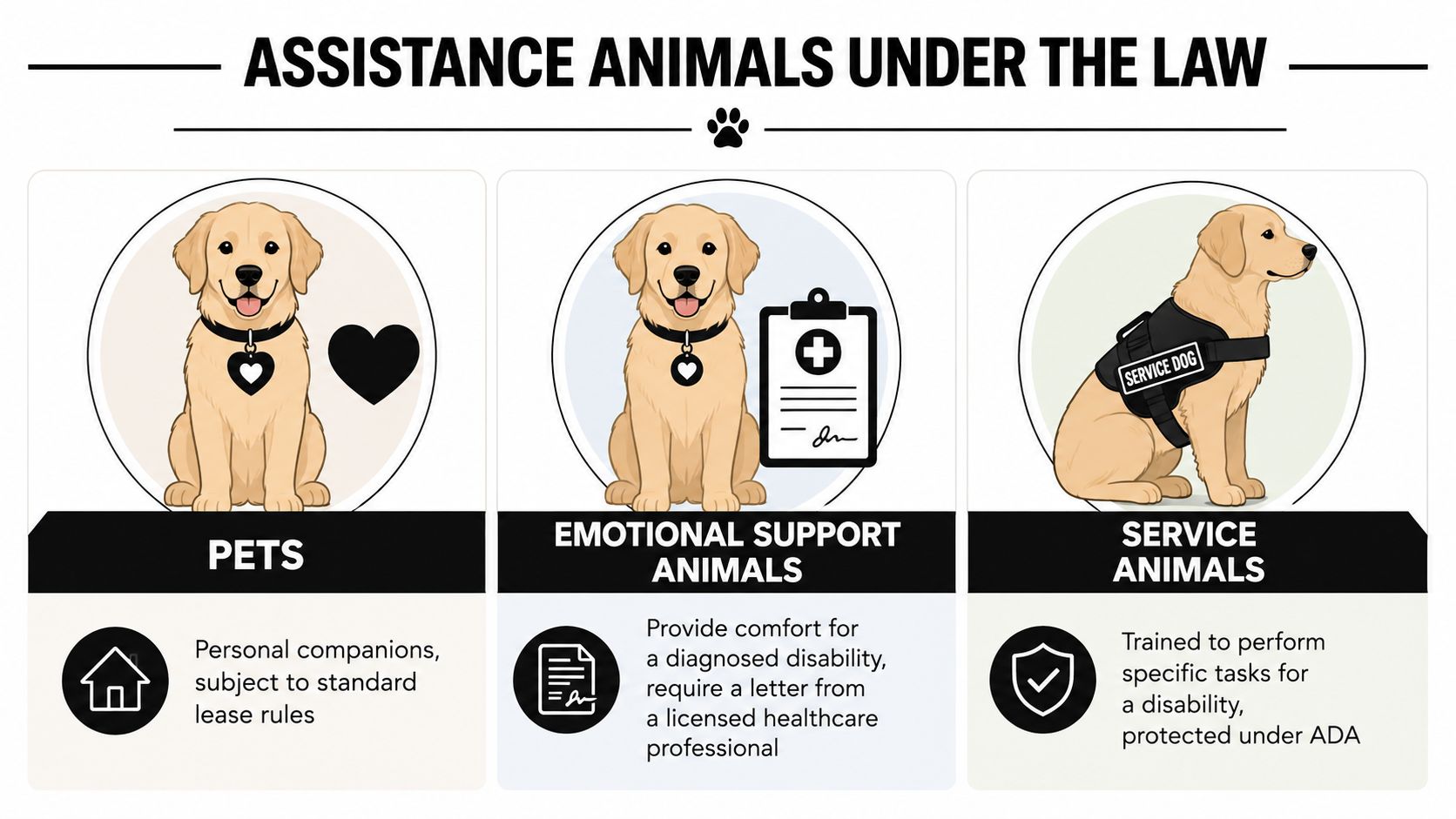
Texas renters and property managers usually confuse three categories, and that confusion drives bad decisions. Pets are ordinary companions. Emotional support animals provide disability-related emotional support in housing. Service animals are trained to perform specific tasks for a person with a disability.
The short version
A pet can usually be restricted by lease terms. An ESA can be protected in housing if the request is valid under the Fair Housing Act framework used in Texas rentals (HUD reasonable accommodation guidance). A service animal has a different legal role, especially under public-access rules, but housing disputes still turn on whether the animal is a reasonable accommodation.
The Texas State Law Library's animal-law guide makes the property side clearer, Texas Property Code Chapter 301 bars fees or deposits for service animals in housing and still leaves the owner responsible for damages beyond ordinary wear and tear (Texas State Law Library service-animal guide). TexasLawHelp also explains that an ESA is an animal providing companionship to a person with a mental or psychiatric disability, which is why ESAs are treated differently from ordinary pets in housing disputes (TexasLawHelp on pets and leases).
What landlords should not do
A property manager can't use pet rules as a shortcut to deny a valid ESA request. Breed caps, weight limits, and pet rent belong in pet policy discussions, not in an ESA denial letter. The better question is whether the accommodation request is supported by reliable documentation and whether the specific animal creates a true, individualized problem.
A landlord's job is to evaluate the request, not the stereotype.
For commercial tenants, this housing framework is separate from Commercial Lease Disputes in Texas, because Texas treats commercial tenancies differently under Chapter 93. That distinction matters, but it does not change the residential ESA analysis.
What Documentation Landlords Can Legally Request
When a disability is not obvious, a Texas landlord can ask for reliable verification of the disability-related need for the animal. HUD guidance allows documentation from a physician, psychiatrist, social worker, or other mental health professional confirming that the animal provides emotional support that alleviates symptoms of an existing disability (HUD service-animal notice). That is the screening line that matters.
What a valid letter should do
A usable letter should identify the professional, show the provider's credentials, and connect the animal to the tenant's disability-related need. Landlords may verify the professional's license, but they should not turn the request into a medical inquisition. The point is to confirm the nexus between the disability and the support animal, not to dig into treatment notes.
Texas tenants and landlords should pay close attention to the red flags around online ESA mills. HUD guidance flags certificates, registrations, and ID cards purchased online as unreliable, and those documents do not replace real verification. A landlord can ask for more information if the paperwork looks inconsistent, especially if the provider has no apparent treatment relationship with the tenant.
Here's the clean checklist.
- Acceptable requests: a written ESA letter, provider credentials, license information, and confirmation that the animal helps with a disability-related need.
- Not acceptable requests: medical records, diagnosis details, therapy notes, or proof that the animal has been trained.
- Careful follow-up: license verification, clarification when the letter is vague, and a request for additional reliable documentation if the first submission looks suspicious.
Why privacy still matters
A landlord may not contact the provider about medical details without written consent. That boundary protects the tenant and also protects the landlord from a privacy complaint. If a landlord wants to confirm the provider is real, verify the license, not the therapy file.
The Texas tenant-screening rules resource also helps landlords stay inside the proper lane when they're asking for information tied to housing eligibility, not medical history (Texas tenant screening rules).
How to Request and Evaluate an ESA Accommodation
Tenants should make the request in writing. A verbal conversation at the leasing office creates proof problems later, especially if the landlord says the request was never made or claims the tenant never provided the letter. The safest move is a short written request, attached documentation, and a saved copy of everything sent.
What tenants should send
Write that you're requesting a reasonable accommodation for an emotional support animal, attach the ESA letter, and identify the animal you plan to keep. Keep the tone factual. A simple statement like, “I am requesting a reasonable accommodation for my emotional support animal based on the attached letter from my licensed healthcare provider,” is usually enough to start the process.
Landlords should answer within a reasonable time and keep the response in writing. A timely response shows the request was reviewed, not ignored. A silence problem can turn into a constructive denial, and that's where many fair-housing complaints begin.
What the response should say
If the landlord approves the request, the response should confirm that the animal is permitted as an assistance animal and state any neutral house rules that still apply, like waste cleanup or leash control. If the landlord denies the request, the response should explain why, in plain English, and tie the denial to a lawful reason rather than a general dislike of ESAs.
Best practice: Treat the request like a paper trail, not a hallway conversation.
If you're the tenant, keep screenshots, emails, portal messages, and delivery confirmations. If you're the landlord, keep a copy of the letter, the date received, the date reviewed, and the exact reason for any follow-up question. That record matters if the dispute later turns into a complaint or a lease fight.
Prohibited Fees Versus Permissible Damage Charges
The distinction is clear. For a valid ESA request in a Texas rental, a landlord generally may not charge pet rent, pet deposits, pet fees, breed surcharges, weight limits, or screening charges under the Fair Housing Act framework and Texas housing guidance. Those are accommodation charges by another name.
What landlords can still recover
Actual damage is different. Texas guidance says the tenant remains responsible for actual damage beyond normal wear and tear. That means a landlord can deduct for real repairs from the ordinary deposit, so long as the charge matches the damage and the file supports it.
A scratched door frame, urine damage, or chewed trim can be billed as damage if the landlord documents it properly. A mandatory ESA cleaning fee or separate animal deposit is not the same thing. It targets the accommodation itself, which is why Texas law treats it differently.
| Charge Type | Legally Permitted? | Legal Basis |
|---|---|---|
| Pet rent for a valid ESA | No | Assistance animal protection under FHA guidance |
| Pet deposit for a valid ESA | No | Same FHA framework and Texas housing guidance |
| Breed or weight surcharge | No | ESA is not a pet for fee purposes |
| Repair for scratched flooring | Yes | Actual damage beyond normal wear and tear |
| Repair for chewed door trim | Yes | Same damage rule |
| Separate animal damage deposit | No | Singling out the accommodation is not allowed |
Landlords still ask about renter's insurance that includes animal liability. Handle that carefully. If the policy is a real insurance requirement applied consistently, that is one issue. If it is a disguised ESA charge, it should be treated as a fee problem. For the narrower Texas rules on that split, see the guide on Texas pet deposit vs pet fee rules.
Keep the record clean. If the animal causes actual harm, document the condition, the repair, and the amount charged. If the charge is just a flat animal fee, remove it. That is the line that matters in Texas ESA disputes.
Common Disputes and Misconceptions About ESAs
The most common mistake is a blanket denial. A landlord sees a breed, a size, or a species they do not like and says no without an individualized review. That approach is risky because ESA analysis cannot rest on stereotypes.
Fraud claims and late requests
Online ESA letters create a second problem. Some documents are legitimate, some are thin, and some are unreliable. A landlord can verify the license and ask for clarification when the request looks off, but a tenant should not be rejected just because the provider is unfamiliar.
Retaliation is another frequent flashpoint. If a landlord raises rent, refuses renewal, or starts eviction steps right after an ESA request, the tenant may claim retaliation rather than ordinary lease enforcement. Texas tenants should keep every message, notice, and timeline.
Property type matters too. Some small owner-occupied buildings may qualify for limited FHA exemptions, so the facts of the property control the analysis. The Texas guidance already discussed in Section 0 explains why landlords should document that exemption issue before they act.
Disputes also get messy when tenants and landlords confuse legal review with consumer advice. Choosing durable gear and protecting the unit are separate concerns, but if a tenant is replacing worn items after approval, how to choose durable pet items is a consumer resource, not a legal defense or a substitute for accommodation review.
Treat a disputed ESA request as a housing-rights issue first. Do not label it a lease violation and sort out the paperwork later.
Post-2026 confusion has made some landlords think every ESA can be handled like a standard pet. That is too blunt. Federal enforcement priorities shift, but Texas fair-housing duties still require a documented, individualized decision on the request and a clear record of any fee or damage charge.
When to Consult a Texas Landlord-Tenant Attorney
Call a Texas landlord-tenant lawyer when an ESA request stops being routine. A tenant should get help if a landlord flatly rejects a valid ESA letter, demands medical records, imposes breed or weight limits, or starts eviction steps after the request. A landlord should get help if the paperwork looks fake, the animal creates a real direct threat, or the property may fit an FHA exemption.
Evidence to gather before calling
Keep the original request, every written reply, the ESA letter, lease notices, repair photos, and any HUD complaint filing. If the animal caused damage, save maintenance records and invoices. If the dispute is turning into a non-renewal or eviction issue, preserve the timeline carefully.
Texas fair housing problems usually get worse when people wait. A quick consultation can show whether the issue is a documentation problem, a fee problem, a retaliation problem, or a discrimination claim. It also helps separate federal enforcement shifts from Texas fair-housing rules, so neither side guesses at what the law requires.
If your situation involves a denied request, suspicious documentation, or possible retaliation, consult a Texas landlord-tenant attorney before the dispute escalates. The Law Office of Bryan Fagan, PLLC offers free 30-minute consultations to review ESA requests, housing disputes, and the records that support your position. Visit The Law Office of Bryan Fagan, PLLC to get started.