Dealing with a landlord dispute or eviction can be stressful, especially when your home no longer feels safe or usable. A tenant may be forced to choose between staying in a property with serious problems and moving out while a lease still appears to require rent. A landlord, meanwhile, may believe a repair dispute is ordinary maintenance while the tenant is building a record for a much larger claim.
That tension sits at the center of constructive eviction in Texas. The doctrine can release a tenant from future lease liability, but it has a strict abandonment requirement. Texas tenants also have a separate statutory repair process under Texas Property Code Chapter 92, which may fit better when the tenant needs repairs but cannot leave. The difference between these paths can determine whether a renter protects their tenant rights or loses influence, and whether a landlord can show responsible management or faces a fact-heavy lawsuit.
When a Texas Rental Becomes Unlivable
In a small duplex in Mason County, a tenant notices that the air conditioner stops working in July. She contacts the landlord, receives repeated promises that someone will come “soon,” and spends six weeks trying to keep her toddler comfortable while asthma symptoms worsen. She now faces an awful choice: move out and risk being accused of abandoning the lease, or stay in dangerous heat while rent remains due.
The law doesn't erase that human pressure. It gives you different legal routes, and each route demands different proof.
A rental problem can fall anywhere on a broad spectrum. A single broken window may require a repair without making the home unusable. Persistent mold, sewage backups, loss of running water, or a heating or cooling failure during extreme conditions can create a much more serious dispute. If a window is damaged and you need a qualified replacement contractor, a resource such as Breaking Glass Co. replacement may help identify the practical repair issue, but hiring a contractor doesn't replace the landlord's legal responsibilities under the lease or Texas law.
Two legal paths
Constructive eviction is a common-law doctrine. It generally applies when the landlord's conduct or failure to act substantially interferes with the tenant's use and enjoyment, effectively forces the tenant to leave, and satisfies the required abandonment rules.
Chapter 92 repair remedies work differently. Texas Property Code § 92.056 gives a tenant a statutory path when the landlord has notice of a condition that materially affects health or safety. Depending on the facts and statutory requirements, the tenant may seek repairs, terminate the lease, repair and deduct, or pursue judicial remedies. The statute creates a rebuttable presumption that seven days is a reasonable repair period for qualifying conditions. See Texas Property Code § 92.056.
Practical rule: Don't move out casually, and don't remain indefinitely while assuming constructive eviction is preserved. Your notice, evidence, and move-out timeline must match the legal remedy you're pursuing.
The renter who recovers usually has a connected record: written notice, proof of severity, failed repair efforts, a prompt move-out, and documentation of losses. The renter who loses may have serious photos and messages but no timely abandonment, no proper notice, or no proof that the condition made the premises substantially unusable.
What Constructive Eviction Means Under Texas Law
You move out after months of flooding, broken air conditioning, or unsafe conditions, then wonder whether Texas law treats that move as forced. Constructive eviction may apply, but it is not a routine repair complaint. It is a narrow common-law theory requiring proof that the landlord's conduct or failure to act seriously interfered with the tenancy and effectively deprived you of the property.
The tenant generally must show that the landlord intended to end the tenant's beneficial use, committed a material act or omission that substantially interfered with use and enjoyment, permanently deprived the tenant of that use and enjoyment, and did not receive a timely abandonment. Missing the move-out requirement can defeat an otherwise serious habitability dispute.
Texas courts of appeals have recognized and applied constructive eviction. The Texas Supreme Court has not expressly adopted the doctrine or resolved its relationship to the covenant of quiet enjoyment. A recent Texas appellate discussion identified that unresolved issue, so the doctrine remains important but unevenly defined in Texas landlord-tenant law. The Texas implied warranty of habitability addresses related living-condition concerns, but it is not the same legal test.
Constructive eviction compared with quiet enjoyment
The covenant of quiet enjoyment protects the tenant's right to use leased premises without substantial interference. Depending on the lease and facts, a tenant may argue that the covenant was breached while still remaining in possession.
Constructive eviction requires a different response because actual abandonment is central. The tenant generally must leave within a reasonable time after the landlord's conduct makes the property unusable. Continuing to live there can undermine the claim that the landlord effectively deprived the tenant of the premises.
Chapter 92 offers a separate statutory route. A qualifying residential tenant can use the repair process after giving the required notice and allowing a reasonable opportunity to cure. Depending on the statutory conditions and facts, that process may support repairs, repair-related relief, continued possession, or lease termination. It is not another name for constructive eviction.
Why the distinction matters
Your chosen theory controls the evidence and potential relief. A tenant who stays may have a stronger statutory repair claim than a constructive-eviction claim. A tenant who leaves may have a constructive-eviction argument, but the condition, landlord's conduct, notices, and timing must support each required element.
These disputes are fact-intensive. Courts examine the lease, communications, inspection records, photographs, repair history, and the tenant's response. Tenants should preserve a dated timeline before sending a termination letter or stopping rent. Landlords should document every complaint, inspection, repair offer, contractor delay, and follow-up. A Texas landlord tenant lawyer should review the complete record before either side takes an irreversible step.
The Four-Part Test Texas Courts Apply
Texas constructive eviction cases use a four-part common-law test. You should assess each element separately because a strong fact on one element won't automatically cure a missing element elsewhere.
First, the landlord must intend to end the tenant's enjoyment
Intent doesn't always require a written admission. Texas authority allows intent to be inferred from circumstances. Repeatedly ignoring written repair requests, deliberately refusing to act after receiving notice, or tolerating a known dangerous condition can support an argument that the landlord intended the tenant to lose the benefit of the lease.
But a slow contractor or an isolated mistake isn't automatically proof of intent. The surrounding record matters. The landlord's written response, inspection efforts, repair scheduling, and follow-up can either strengthen or weaken this element.
Second, a material act or omission must substantially interfere
The condition must be serious. Persistent flooding, no running water, raw sewage, or major HVAC failure during extreme heat may support material interference because the premises no longer function for ordinary residential use.
A minor inconvenience generally isn't enough. A single leaky faucet, cosmetic damage, or an easily corrected issue may require attention without amounting to constructive eviction. The tenant must connect the condition to the landlord's conduct or failure to act. Tenant-caused damage usually doesn't satisfy this requirement.
Third, the tenant must be permanently deprived of use and enjoyment
“Permanent” doesn't necessarily mean the condition can never be repaired. It means the interference must be substantial and continuing enough that the tenant has effectively lost the leased use, rather than experiencing a temporary inconvenience.
A chronically flooded bathroom can be more significant than an isolated leak because the tenant may be unable to use a basic part of the home over an extended period. Medical records, inspection reports, utility records, videos, and dated communications can help show severity and duration.
Fourth, the tenant must abandon within a reasonable time
This is often the most disputed element. The tenant must leave within a reasonable time after the landlord's conduct becomes intolerable. Waiting weeks or months while continuing to occupy the premises can give the landlord a strong argument that the tenant accepted the lease and the condition.
Texas appellate courts evaluate these elements when reviewing motions for summary judgment and trial records. That means evidence collected early can decide whether the case proceeds at all. Save the original messages, preserve metadata where possible, and create a dated timeline before memories and repair records become difficult to reconstruct.
Why Staying Usually Kills a Constructive Eviction Claim
A tenant who remains in possession usually has a serious problem with a constructive-eviction theory. Courts generally view continued occupancy as inconsistent with the claim that the landlord's conduct permanently deprived the tenant of the premises. The tenant may still have a repair claim, damages claim, lease-breach argument, or quiet-enjoyment theory, but constructive eviction requires a clean connection between the interference and the move-out.

Choose the right track
Think of the options this way:
| Your situation | More realistic legal direction |
|---|---|
| You remain in the unit and need a serious health or safety repair | Texas Property Code Chapter 92 repair-and-remedy process |
| You leave because the premises became substantially unusable | Possible constructive eviction, if the four-part test is met |
| You have a dispute over interference but remain in possession | Possible lease-breach or quiet-enjoyment theory, depending on the facts |
| You caused the damage | The landlord may have repair, rent, or damage claims instead |
Texas repair law requires its own notice and procedure. The Texas Attorney General explains that notice should be dated, delivered by certified mail with return receipt requested, registered mail, or in person, with a copy retained. If the first notice wasn't sent by certified or registered mail and the landlord still doesn't act within a reasonable time, a second notice may be required. See the Texas Attorney General renters' rights guidance.
Common mistakes include waiting too long to leave, accepting partial rent arrangements without understanding their effect, and relying only on oral notice. A tenant may also continue paying rent to avoid an eviction case, but payment and possession records can complicate the argument that the lease was effectively terminated.
For a tenant who cannot move, Chapter 92 may offer the practical route. The guidance on withholding rent for repairs in Texas should be reviewed carefully because repair remedies aren't a license to stop paying rent whenever a dispute arises.
The core decision is practical: constructive eviction is an exit-based remedy. If you need to stay, build the statutory repair record. If you leave, make the timing, notice, condition, and damages record unmistakable.
How Texas Tenants Can Build a Strong Claim Step by Step
A strong claim starts before the move-out. Treat the dispute like a legal record, not a series of frustrated conversations.
Step one, document the defect
Photograph and video the condition from multiple angles. Capture water intrusion, standing water, visible mold, broken equipment, temperature problems, sewage, or loss of utilities. Note dates and times, identify the affected rooms, and save related utility bills, medical records, inspection reports, weather information, and contractor communications when they directly support the severity of the condition.
Create one folder with the lease, rent ledger, notices, text messages, emails, photographs, videos, and receipts. Don't edit the original files or rely only on screenshots that omit dates and sender information.
Step two, send precise written notice
Identify the property, the lease, the exact defect, when it began, and how it affects ordinary use. Send the notice using a legally reliable method, including certified mail when appropriate, and keep the receipt, delivery confirmation, and a duplicate copy. Email can supplement the formal notice, but don't assume an informal text message satisfies every statutory or lease requirement.
A clear notice gives the landlord a meaningful chance to inspect and repair. It also prevents the landlord from arguing that the condition was hidden or that the tenant never explained its seriousness.
Step three, allow a reasonable cure period
Texas Property Code § 92.056 creates a rebuttable presumption that seven days is reasonable for a qualifying health or safety condition, but the facts and the type of repair still matter. An emergency may require faster action, while a complex repair may involve scheduling and temporary measures.
Write down every promised repair date. If the landlord sends a contractor, record who arrived, what was inspected, what was attempted, and whether the condition continued.
Step four, move out and preserve the timeline
If the property has become substantially unusable and repairs haven't resolved the problem, the decisive step is vacating within a reasonable time. Secure your belongings, photograph the condition at move-out, return keys in a documented manner, provide a forwarding address, and send written notice explaining that the landlord's conduct substantially interfered with your use of the premises.
Mitigate your losses. Keep receipts for temporary housing, storage, moving expenses, replacement utilities, and other reasonable costs. Avoid unnecessary upgrades that make damages harder to prove. Before surrendering the property, use a written inspection record and preserve evidence of its condition. Tenants and landlords should also understand the Security Deposit Rules in Texas, including the 30-day return rule under Chapter 92.

This video can help frame the practical issues tenants face while organizing a rental dispute:
Don't promise yourself that every loss is recoverable. Rent abatement, moving costs, and other damages depend on the evidence, lease language, causation, and the legal theory. Emotional distress damages require particular care and shouldn't be assumed merely because the situation was upsetting.
How Texas Landlords Can Prevent Constructive Eviction Claims
The best landlord defense begins with action, not courtroom arguments. A prompt repair response, paired with a reliable written record, can show that the landlord did not intend to deprive the tenant of use and did not ignore a substantial condition.
Build a written repair system
A landlord or property manager should acknowledge every repair request in writing within 24 to 48 hours as a management practice. The response should confirm receipt, identify the next inspection step, and tell the tenant who will handle the issue.
Inspect the property and record the findings. Then send a written cure plan that identifies the work, the contractor or employee assigned, the target completion date, and any temporary measure. For a serious HVAC, water, mold, or sewage problem, consider whether temporary housing or a unit transfer is appropriate. A practical accommodation can reduce disruption and create evidence that the landlord worked to mitigate harm.
Keep the file stronger than the accusation
Use a single maintenance file for each dispute. Include:
- Request records: Preserve the tenant's original notice, the date received, and the method of delivery.
- Inspection notes: Record what the inspector saw, where the condition appeared, and whether tenant conduct contributed.
- Service documents: Keep work orders, contractor invoices, parts information, photographs, and completion notes.
- Communication logs: Save updates, scheduling attempts, access problems, and the tenant's response.
- Follow-up proof: Take before-and-after photographs and confirm in writing whether the repair resolved the issue.
Texas Property Code § 92.052 addresses a landlord's duty to make repairs under applicable conditions. Section 92.056 supplies the statutory repair-and-remedy framework, including the rebuttable seven-day presumption for qualifying health and safety conditions. A landlord should not assume that lease language eliminates these statutory obligations.
Draft leases for predictable maintenance
Lease language should explain HVAC service responsibilities, pest-control reporting, water intrusion, emergency contact procedures, and the tenant's obligation to report conditions promptly. It should also explain access and scheduling expectations without attempting to waive rights that Texas law protects.
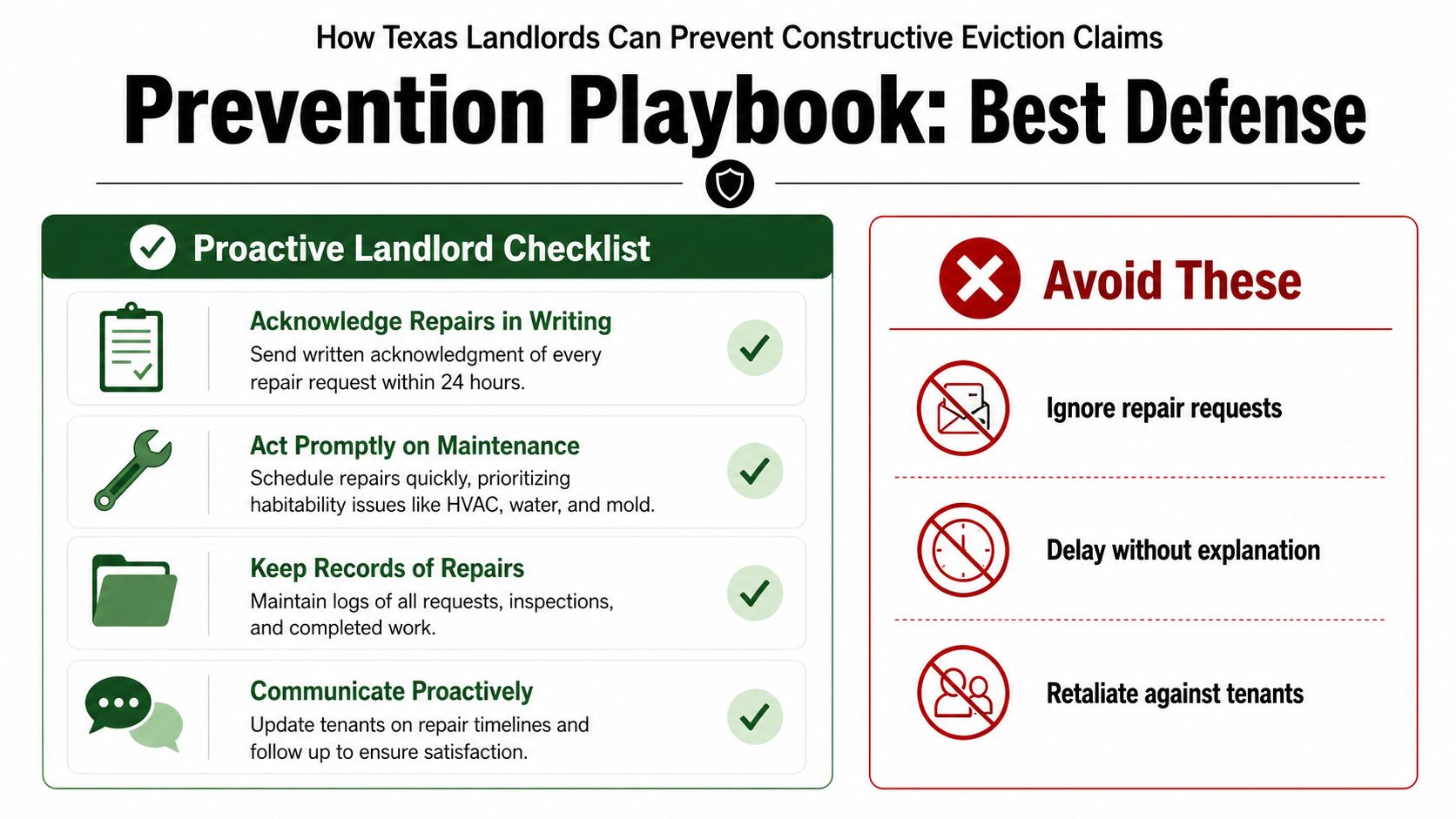
Avoid the habits that create damaging evidence: ignoring requests, delaying without explanation, threatening a tenant for complaining, or retaliating after a repair demand. The landlord's file should make the timeline easy to understand. If a court sees prompt inspection, documented repairs, regular updates, and reasonable mitigation, the landlord is in a much stronger position.
Texas Statutes and Cases That Shape These Disputes
The statutory framework and common-law doctrine operate together, but they aren't the same. Texas Property Code § 92.056 provides the repair-and-remedy path for qualifying residential conditions after notice. Section 92.0561 addresses repair-and-deduct procedures, while Section 92.058 supplies the rebuttable presumption that seven days is reasonable for a condition materially affecting health or safety. Section 92.062 addresses retaliation, which can become important when a landlord responds negatively to a tenant's repair request or legal complaint. A useful overview of Texas Property Code tenant rights can help orient you to these provisions.
The common-law side comes from appellate decisions applying the four-part constructive-eviction test. Those cases focus on landlord intent, substantial interference, permanent deprivation, and timely abandonment. A notable Texas appellate opinion also explains that a tenant who proves constructive eviction is relieved of contractual liability for remaining rent under the lease, showing why the doctrine can materially change the economics of a dispute. See the Texas appellate opinion discussing constructive eviction and remaining rent liability.
A 2022 Denton County appellate case involved a jury award of $4,903.37 on a constructive-eviction claim and discussed remittitur based on evidence supporting only part of that award. See the Denton County constructive-eviction decision. A separate 2020 Fifth Court of Appeals decision reaffirmed the need for a valid landlord-tenant relationship and abandonment within a reasonable time.
Don't overstate the cases. The Texas Supreme Court hasn't expressly adopted constructive eviction or resolved its relationship to quiet enjoyment, as discussed in a recent Texas appellate reference. Federal bankruptcy decisions and out-of-state cases may offer persuasive reasoning, but they aren't controlling in a Harris, Dallas, or Travis County courtroom. Confirm current citations before relying on any case in a filing.
Practical Questions Texas Renters and Landlords Ask Next
How long do I have to sue? The answer depends on the claim, the lease, the injury or loss, and when the cause of action accrued. Don't assume the constructive-eviction label gives you a single universal deadline. Have a Texas landlord tenant lawyer evaluate the facts promptly.
Does Chapter 92 apply to commercial leases? The residential repair remedies in Chapter 92 generally don't govern commercial leases. Commercial tenants usually rely more heavily on lease language, common-law constructive eviction, quiet enjoyment, and breach-of-contract theories.
Can a landlord counterclaim? Yes. A landlord may assert claims for unpaid rent, property damage, or lease-abandonment losses. A tenant's move-out letter doesn't automatically eliminate those claims.
Is small-claims court realistic? It may be practical for a limited, document-heavy dispute, but complex habitability evidence, lease interpretation, possession issues, or substantial damages may require a different court and litigation strategy. A tenant or landlord should ask an attorney about fees, county-specific experience, and whether mediation fits the dispute. Before accepting completed repair work, document the condition and verify remodel quality before paying.
Seek a free consultation quickly if the dispute involves health hazards, an attempted lockout, utility shutoffs, retaliation, or a landlord who refuses to accept rent. You can also check the State Bar of Texas lawyer referral service, local legal aid, and any Justice Court standing orders that apply in your county.
The Law Office of Bryan Fagan, PLLC helps Texas tenants and landlords evaluate repair disputes, constructive-eviction theories, lease enforcement, security deposits, and eviction defenses. Visit The Law Office of Bryan Fagan, PLLC to schedule a free consultation, bring your lease and repair records, and receive a clear strategy for protecting your property rights.