You've accepted a job in another Texas city, but your apartment lease still has months left. The move may be necessary, yet job relocation alone usually doesn't cancel a Texas residential lease. Before you hand over the keys, identify your lease type, protect your security deposit, and get any agreement with your landlord in writing.
For a civilian tenant, this is usually a negotiation governed by the lease and the Texas Property Code. A servicemember with qualifying military orders may have a protected statutory exit. The difference can determine whether you're negotiating a release or exercising a legal right.
Why Texas Treats Job Relocation as a Negotiation, Not a Legal Right
Texas law doesn't give civilian tenants a special statutory right to end a fixed-term lease early because they're moving for a new job. In practical terms, you may still owe rent through the lease term unless your landlord agrees to release you, the lease includes an early-termination option, or the unit is re-rented and your damages are reduced under the landlord's duty to mitigate. The Texas State Law Library's guidance on ending a lease identifies moving for a new job or out of state as a personal reason, not a protected basis for ending a fixed-term lease.
That doesn't mean you're powerless. It means you should treat breaking a lease for job relocation in Texas as a documented exit negotiation, not as a notice loophole. Your four practical concerns are the notice rules for your tenancy, the military exception under Texas Property Code Section 92.017, the landlord's mitigation duties, and the written terms of your negotiated surrender.
Practical rule: Don't move out based on a verbal promise that “we'll work something out.” A signed release is what protects you from a later rent claim.
Your exposure depends on what happens after you leave. If the landlord re-rents the home, the landlord generally can't collect rent from both tenants for the same period. If the landlord doesn't make reasonable efforts to re-rent, that failure can matter under Texas Property Code Section 91.006. But mitigation doesn't automatically erase every charge. You can still face unpaid rent already due, lawful repair or cleaning charges, and other amounts allowed by the lease and Texas law.
Major markets such as Houston, Dallas-Fort Worth, Austin, and San Antonio often involve fast-moving rental inventory and professional property managers. That makes written notice, listing records, applicant communications, and a clear move-out agreement especially important. Your goal isn't just to leave. Your goal is to establish exactly when your obligations end and how the landlord will account for your deposit.
The Texas Property Code Sections That Actually Apply to Your Move
The first question is whether you have a fixed-term lease or a month-to-month tenancy. The answer changes your notice rights, but it doesn't turn an ordinary civilian job move into a statutory lease exception.
Texas Property Code Chapter 91 addresses termination of periodic tenancies. For a residential month-to-month tenancy, either party can generally terminate by giving written notice. When the rent-paying period is less than one month, the tenancy ends on the later of the date stated in the notice or the day after a notice period equal to the rent-paying period has run. In ordinary practice, a tenant should give at least one full rental period of written notice, usually 30 days, as described in this Texas month-to-month notice guide.
A fixed-term tenant doesn't receive that same exit merely by giving standard notice. If your lease runs through a stated end date, moving for a job generally leaves you responsible under the contract unless an early-termination clause, negotiated release, qualifying statutory protection, or re-rental changes the calculation. The lawful grounds for ending a Texas lease early for both parties are summarized in Lease Termination and Breaking a Lease in Texas.
The military route under Section 92.017
Texas Property Code Section 92.017 applies to qualifying servicemembers and dependents, not ordinary civilian employees. The protection can apply when the lease was signed before or during military service and the servicemember later receives qualifying permanent change-of-station orders or deployment orders for a period of 90 days or more. The statute requires written notice and military documentation. See the text of Texas Property Code Section 92.017.
Once proper notice is delivered, termination generally takes effect 30 days after the next rent payment becomes due. That timing is different from a civilian's ordinary job-relocation negotiation. A servicemember should attach the actual orders and identify the statutory basis clearly instead of describing the move only as a work transfer.
| Issue | Civilian Tenant | Servicemember under Sec. 92.017 |
|---|---|---|
| Job relocation by itself | Usually no statutory early-release right | Military orders may create a protected right |
| Notice | Follow the lease or applicable periodic-tenancy rule | Written notice plus qualifying orders |
| Future rent | May remain due until release, re-rental, or lease end | Future rent liability can end under the statute |
| Timing | Controlled by lease, agreement, or tenancy type | Generally effective 30 days after the next rent payment is due |
| Documentation | Lease, relocation proof, and delivery records | Lease, written notice, and military orders |
Landlords also have mitigation obligations under Texas Property Code Section 91.006. That provision becomes important after a civilian tenant leaves or a lease ends early. It doesn't give you permission to abandon the unit, but it can limit a landlord's ability to leave the property empty and charge you indefinitely.
Writing a Job-Relocation Notice That Protects Your Deposit
Your notice should make the facts easy to verify. Send a dated letter that identifies the landlord, every tenant, the rental address, the lease date, and the move-out date you're requesting. State plainly that you're relocating for employment and ask for a written mutual termination or release.
For a civilian tenant, choose the proposed date carefully. If you're month to month, calculate the notice under the rental period and your lease. When possible, request a move-out date that lands on the last day of a rental month, because that avoids confusion about partial rent periods and possession.
Attach documents that show the relocation is real. A job offer letter, employer relocation memo, or transfer paperwork should identify the new work location and should be dated before the notice. Don't send unnecessary private information such as compensation details if the landlord doesn't need it. For a servicemember relying on Section 92.017, attach the actual military orders required by the statute.
Build a clean notice packet
Include these items in one organized submission:
- Notice letter: State the requested termination date, relocation reason, and requested release terms.
- Lease excerpt: Include the early-termination, notice, assignment, and move-out provisions.
- Relocation proof: Attach the offer letter, transfer memo, or other employment document.
- Orders, if applicable: Servicemembers should attach qualifying permanent-change-of-station or deployment orders.
- Forwarding address: Provide the address where the landlord can send the deposit accounting.
- Delivery proof: Keep the receipt, tracking record, hand-delivery acknowledgment, or portal confirmation.
Email can be useful, but it may not satisfy a lease that requires certified mail, hand delivery, or another specific method. Follow the lease's notice clause, then send a duplicate through a method that creates a reliable record. Keep the entire message thread and every attachment.
A civilian relocation notice doesn't, by itself, stop rent from accruing under a fixed-term lease. It starts the conversation and preserves evidence. The security-deposit rules also require attention. Under Texas law, the landlord generally must return the deposit within 30 days after surrender of the premises and receipt of your forwarding address, less lawful deductions. Review the lease and Texas security-deposit itemized deduction rules before selecting your move-out date, especially if the lease makes advance notice a condition of deposit return.
How Mitigation Works and What It Typically Costs You
Take a Houston-to-Austin move. You give notice on March 1, your fixed-term lease runs through August, and you leave because the new employer expects you to report in Austin. The landlord lists the home on March 5 and signs a lease with a qualified tenant who moves in June 1.
Your likely rent exposure isn't automatically every remaining month through August. The landlord has to make reasonable efforts to re-rent under Texas Property Code Section 91.006. The landlord should actively market the unit, show it to applicants, and evaluate qualified replacements. The landlord shouldn't keep the home vacant while waiting for a higher rent than your lease required.
The rent calculation still needs careful separation. If you already paid March, that payment isn't necessarily a refundable lease-break payment. You may face a gap for April and May, depending on the agreement, possession date, re-rental date, and the landlord's accounting. You may also face lawful cleaning, damage, unpaid utilities, or administrative charges authorized by the lease. A landlord can't label every cost a “reletting fee” without support in the lease or applicable law.
What to document
Save the original listing, screenshots showing when the unit was advertised, showing instructions, communications with the property manager, and names of replacement applicants you referred. If the landlord rejects an applicant, request the reason in writing. If the unit disappears from the market or remains vacant without explanation, preserve that evidence before sending accusations.
Finding an approved replacement may reduce the dispute, but don't move a stranger into the unit without written approval. Review the practical issues in taking over someone's Texas lease before proposing an assignment.
| Re-Renting Outcome | Lost Rent | Re-Leasing and Cleaning Fees | Total Exposure |
|---|---|---|---|
| Unit re-rented promptly at the same rent | Limited vacancy-related loss, subject to the agreement and accounting | Lawful, documented charges may remain | Usually lower and easier to calculate |
| Unit re-rented after a gap | Rent for the documented gap may be claimed | Cleaning, repairs beyond normal wear, or authorized re-leasing charges may apply | Gap rent plus supported charges |
| Unit re-rented at a lower rent | Possible difference during the remaining lease period, subject to mitigation | Lawful charges may still apply | Depends on the lease, timing, and replacement terms |
| Unit left vacant without reasonable marketing | Disputed future rent claim | Unsupported charges should be challenged | Evidence of failed mitigation can reduce the claim |
There's no honest universal dollar figure without knowing your monthly rent, remaining term, lease clauses, and deposit. The actual cost range runs from a negotiated release with limited documented charges to substantial remaining-rent exposure if the property isn't promptly re-rented and no settlement is signed. Get the landlord's proposed accounting before you assume the move is affordable.
Negotiating an Early Exit That Actually Sticks
Start with the lease, not a threat. Find the early-termination clause, buyout language, notice requirements, assignment restrictions, reletting fees, cleaning standards, and security-deposit provisions. Then send a short proposal that gives the landlord a practical choice: release you on a defined date, approve a qualified replacement, or agree to a specific buyout.
A good written mutual termination should identify the effective date, the date you'll surrender possession, the amount you'll pay, and the obligations that end. It should also state whether the landlord releases future rent, reletting costs, utilities, concessions, and other lease claims. If the landlord intends to keep any part of the deposit, the agreement should identify the reason and preserve the statutory accounting process under Texas Property Code Section 92.103.
Use one of four workable structures
- Mutual termination and release: You pay an agreed amount, return possession, and receive a signed release of future obligations.
- Lease assignment: A replacement tenant takes over after landlord approval. Confirm whether you remain liable after the assignment.
- Approved sublet: Another occupant pays rent while you remain connected to the lease. Get written approval and understand that a sublet may not release you.
- Early-termination fee: If the lease allows a buyout, follow its notice and payment terms. If it doesn't, negotiate the amount instead of assuming a fee is automatically valid.
Section 91.006 can affect mitigation, while assignment language and landlord consent requirements can create separate problems. Don't treat a replacement applicant as a completed transfer until the landlord signs the assignment or release.

The agreement should say who pays the re-leasing fee, whether the deposit is applied to the settlement, when the tenant must vacate, how keys are delivered, and whether an inspection will occur. It should also confirm that the landlord won't pursue the same released obligation later under a different label.
Verbal approval from a property manager isn't enough. Ask for a document signed by the landlord or an authorized representative, keep a complete copy, and don't rely on a text message that lacks the final financial terms.
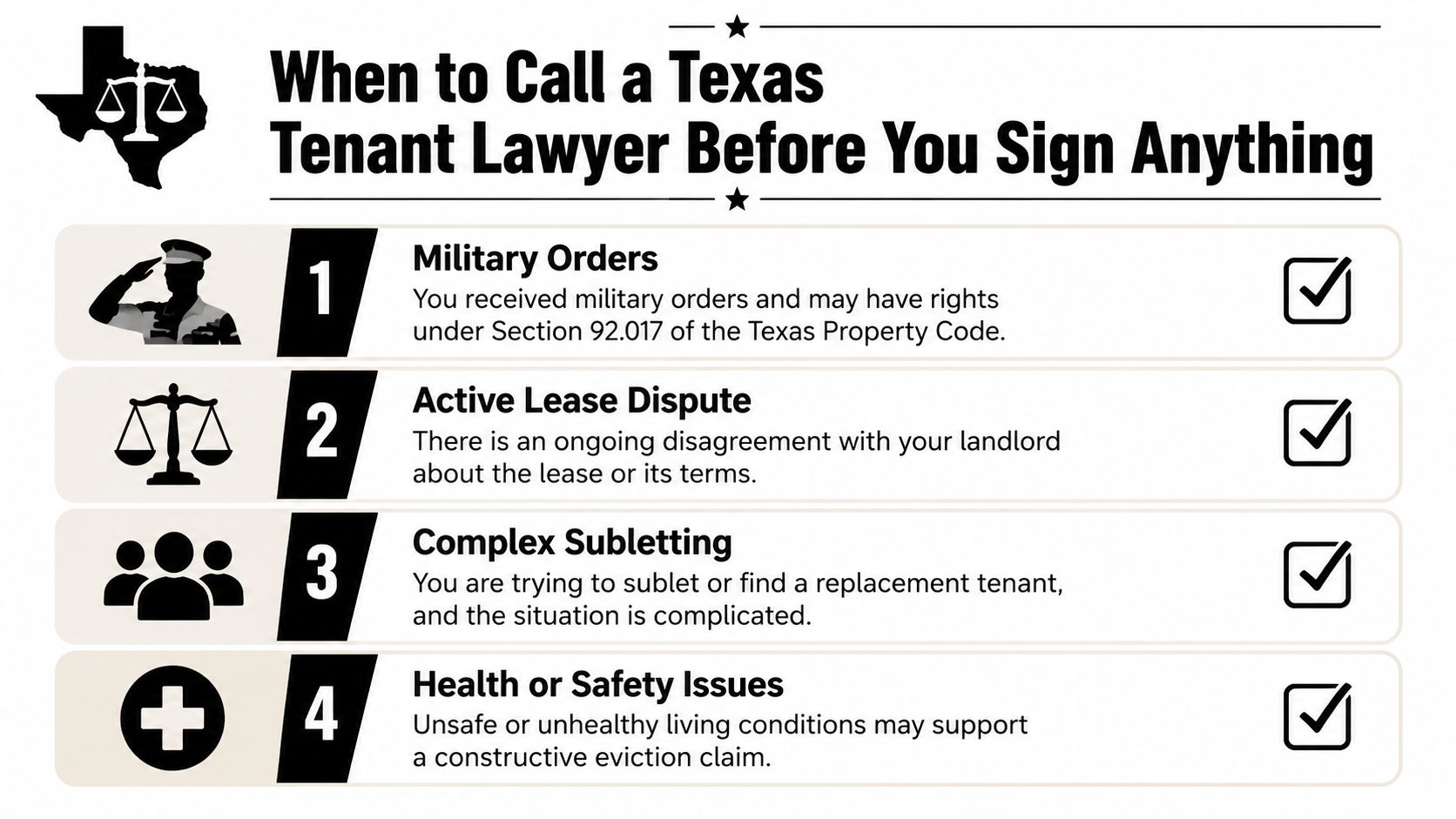
When to Call a Texas Tenant Lawyer Before You Sign Anything
Giving notice doesn't automatically end a fixed-term lease. That assumption causes renters to move out, spend money on the new home, and then discover that the landlord still claims rent, fees, or damages. A Texas landlord tenant lawyer can review the lease and proposed exit before your position becomes harder to fix.
Call for legal review at these trigger points:
- Military orders: If you believe Section 92.017 applies, have counsel confirm the orders, notice, timing, and delivery method.
- Active lease assignment: If the landlord is delaying approval, rejecting replacements without a clear reason, or changing the proposed terms, document the dispute before proceeding.
- A large deposit at risk: If your deposit is more than $1,000, a focused review may be sensible before you sign a release that gives up deposit rights.
- A landlord-drafted agreement: Have an attorney review any termination agreement prepared by the landlord or its attorney before you sign it.
Watch for clauses that waive habitability or repair claims, impose broad indemnification obligations, or create penalties that apply only to you. A release can solve the rent problem while giving away unrelated rights. If the landlord says the agreement is “standard,” read it anyway. Standard forms still control your legal obligations once you sign.
Affordable help may be available through Texas Legal Aid, the State Bar Lawyer Referral Service, or limited-scope representation focused on reviewing one notice or settlement document. You don't always need full litigation assistance to avoid signing an unfavorable release. A focused consultation can clarify whether your lease includes a buyout, whether mitigation evidence matters, and whether the landlord's proposed accounting is supported.
You can also consult a firm that handles lease disputes and tenant protections, such as Texas rental lawyer services. Bring the lease, rent ledger, relocation paperwork, communications, proposed agreement, and photographs from your move-out inspection. That gives the attorney the facts needed to evaluate your options efficiently.
If your job transfer has put your Texas lease and security deposit at risk, The Law Office of Bryan Fagan, PLLC can review your lease, relocation notice, proposed release, and landlord communications. Visit The Law Office of Bryan Fagan, PLLC to schedule a free consultation and get a practical strategy for ending the tenancy while protecting your tenant rights.