A Texas landlord won't automatically pay for every bed bug infestation, but responsibility may arise when the tenant gives proper written notice, rent is current, the tenant didn't cause the infestation, and the landlord fails to act within about seven days. Texas bed bug liability usually turns on that sequence, not on the fact that insects were found.
A Houston renter may discover itchy welts after moving into an apartment, inspect the mattress seam, and find live bugs hiding in the stitching. The immediate worries are practical and frightening: lost sleep, repeated laundry, possible treatment costs, and the fear of carrying bugs to clothing, relatives, or another apartment. The renter may also wonder whether next month's rent is still due.
The landlord faces a different but related problem. A quick denial, an unsupported charge, or treatment limited to one unit can allow a manageable complaint to become a documented habitability dispute. The important questions are who received notice, whether rent was current, who may have caused the infestation, whether the property was inspected, what treatment occurred, and whether follow-up confirmed the problem was addressed.
Texas uses its broader repair-and-remedy framework rather than one single bed bug statute. Public-health guidance also matters, while proposed legislation must be separated from rules that are currently enacted.
When Bed Bugs Create a Texas Rental Dispute
A tenant's first report often contains uncertainty. Bites alone don't prove bed bugs, and a dark mark on a mattress may have another explanation. But once a renter sees a live insect, shed skin, fecal spotting, or repeated activity around sleeping areas, delaying notice creates unnecessary risk.
The renter should report the concern promptly and in writing. The property manager should acknowledge it, arrange an inspection, and avoid deciding responsibility before the evidence is reviewed. A professional identification matters because the legal and practical response depends on what is present.
Practical rule: Treat the first written report as the beginning of a record, not as an accusation that can be ignored.
The disruption can become serious even before a court becomes involved. A tenant may stop sleeping normally, wash clothing repeatedly, move furniture, or throw away personal belongings. A landlord may need to consider neighboring units, common areas, and the possibility that an isolated treatment won't solve the source.
The questions that usually control the dispute
Both sides commonly ask:
- Who pays: The lease, the source of the infestation, the condition of the property, and the parties' conduct all matter.
- Whether rent can be withheld: A tenant's frustration doesn't automatically create a right to stop paying rent.
- How fast the landlord must act: Texas repair guidance commonly gives a landlord about seven days after written notice to act in the circumstances described by Texas tenant-rights guidance. Texas Law Help explains the bed bug repair process.
- Whether the tenant caused the problem: Bringing in used furniture may be relevant, but source disputes require evidence rather than assumptions.
A strong analysis follows the order of events. Notice comes first, followed by rent status, causation, inspection, treatment, and verification. That sequence helps a worried renter preserve rights and helps a property owner show that the response was reasonable.
The sections below distinguish current Texas repair rules and public-health treatment of bed bugs from HB 3882, a 2021 proposal that wasn't enacted. A proposed bill can show legislative interest, but it doesn't replace the law that applies today.
How Texas Law Triggers Landlord Responsibility
Texas landlord responsibility generally begins with the implied warranty of habitability and the repair-and-remedy provisions of Texas Property Code Chapter 92. Section 92.052 requires a landlord to make a diligent effort to repair a condition that materially affects an ordinary tenant's physical health or safety, subject to statutory requirements and defenses. Bed bugs aren't separately listed in that section as a special designated condition, so the facts and the lease matter.
The first step is notice. A tenant generally must give written notice of the condition, unless the lease recognizes another valid notice method. The notice should identify the unit, describe the suspected infestation, state when it was observed, and request inspection or repair. A tenant who is late on rent may face a serious obstacle because Texas repair remedies generally depend on the tenant being current under the circumstances addressed by the statute.
The landlord then must receive a reasonable opportunity to act. Texas tenant-rights guidance states that a landlord usually has about seven days after receiving written notice to respond to a bed bug condition in the described circumstances. That isn't permission to wait casually. A reasonable response may require inspection, species confirmation, professional treatment, and follow-up, especially in a multi-unit property.
For a broader explanation of the warranty concept, see this discussion of the Texas implied warranty of habitability. The lease can allocate routine pest duties, but a clause doesn't automatically excuse a landlord from addressing a condition that materially affects health or safety.
Causation remains central
The presence of bed bugs doesn't prove who introduced them. A prior tenant, used furniture, visitors, adjacent units, shared walls, or common areas may all be relevant. If the tenant caused the infestation, the landlord may have a stronger claim for costs or lease enforcement. If the insects pre-existed the tenancy or migrated through the building, the landlord's exposure may be stronger.
Texas public-health treatment adds another layer. The U.S. EPA's Texas bed bug law summary states that Texas treats bed bugs as a public-health nuisance under Texas Health & Safety Code § 341.011 and requires the person in possession of real property to abate the nuisance once known. That framing supports a coordinated response rather than a narrow argument about one tenant's mattress.
| Element | What the Tenant Must Show | Typical Texas Source |
|---|---|---|
| Written notice | The landlord received a clear report of the condition | Texas Property Code repair-and-remedy framework |
| Rent status | Rent was not delinquent under the applicable circumstances | Texas Property Code repair-and-remedy framework |
| Health or safety impact | The condition materially affects ordinary use, health, or safety | Texas Property Code § 92.052 |
| Landlord response | The landlord failed to make a diligent effort within a reasonable time | Texas Property Code Chapter 92 |
| Causation | Evidence connects the condition to the property, another unit, or tenant conduct | Lease and case-specific proof |
For readers comparing landlord pest-control rules in another market, Pestless Inc.'s explanation of who pays for pest control in Miami illustrates why lease language and the source of the infestation often matter. Texas analysis still depends on Texas law and the specific facts.
Tenant and Landlord Duties Compared
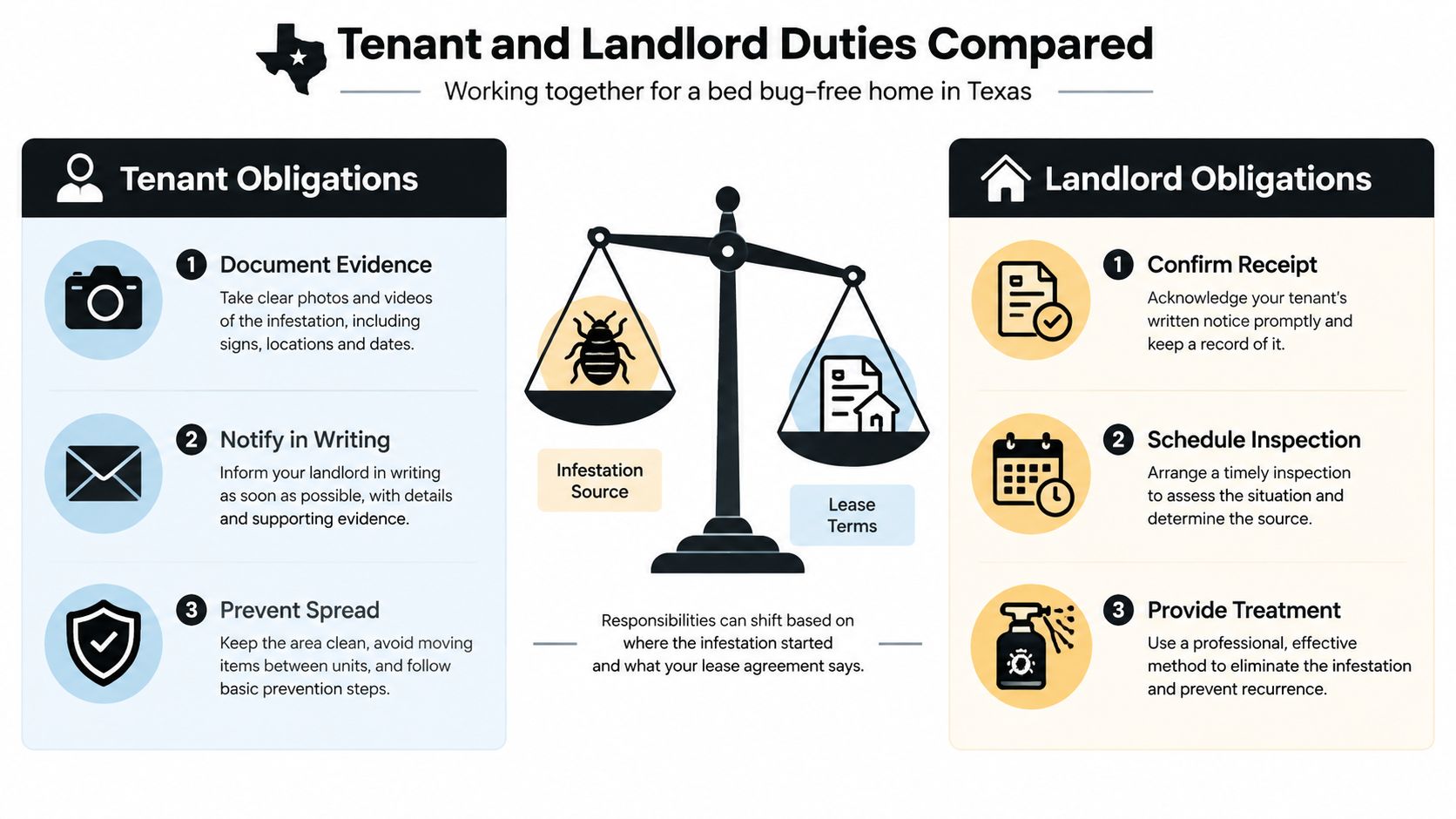
Bed bug responsibility isn't a one-sided checklist. Once a report is made, the tenant and landlord each control part of the outcome. The tenant controls access, truthful reporting, preparation, and continued compliance with the lease. The landlord controls investigation, professional treatment, communication, and property-wide coordination.
A lease may impose stricter obligations than the general framework. For example, it may require immediate notice, preparation before treatment, or access for follow-up visits. Those provisions don't eliminate the need to analyze habitability, causation, and the landlord's legal repair duties.
The tenant's side of the record
A tenant should report suspected activity in writing, permit lawful access, and follow reasonable preparation instructions. Moving bedding or furniture into another unit can spread the problem and make causation harder to evaluate. A tenant should also avoid self-treatment that scatters insects or interferes with a professional's inspection.
The tenant's rent status matters. Stopping payment out of fear or anger may give the landlord an eviction defense even if the original repair complaint was legitimate. Unless a court or a carefully followed statutory remedy authorizes another course, keeping rent current is an important risk-control step.
The landlord's side of the record
A landlord should arrange a qualified inspection, confirm whether the pest is a bed bug, and use a licensed pest-management professional when treatment is needed. In a multi-unit building, the landlord should consider adjacent units and possible migration through shared structures or common areas.
Treatment may include chemical or heat protocols, mattress and furniture encasements, preparation instructions, and follow-up inspections. The landlord should preserve communications, inspection findings, vendor credentials, treatment plans, invoices, access records, and verification results.
Tenant cooperation often supports landlord performance, while landlord documentation often determines whether that performance can be proved.
If either party refuses to participate, the later claim becomes harder to establish. A tenant who blocks access may undermine an argument that the landlord failed to repair. A landlord who blames the tenant without inspecting may weaken a causation defense.
What Tenants Should Do After Finding Bed Bugs
Start with evidence, not panic. Photograph the insect, mattress seam, spotting, or other relevant condition. If possible, preserve a specimen in a sealed bag so an inspector can identify it. Bites can support concern, but physical evidence and a professional inspection usually provide a stronger record.
Don't move furniture, clothing, or bedding into another room or unit unless a professional instructs you to do so. Avoid spraying multiple products before inspection because self-treatment can scatter insects, create chemical concerns, or make it harder to determine what was present.
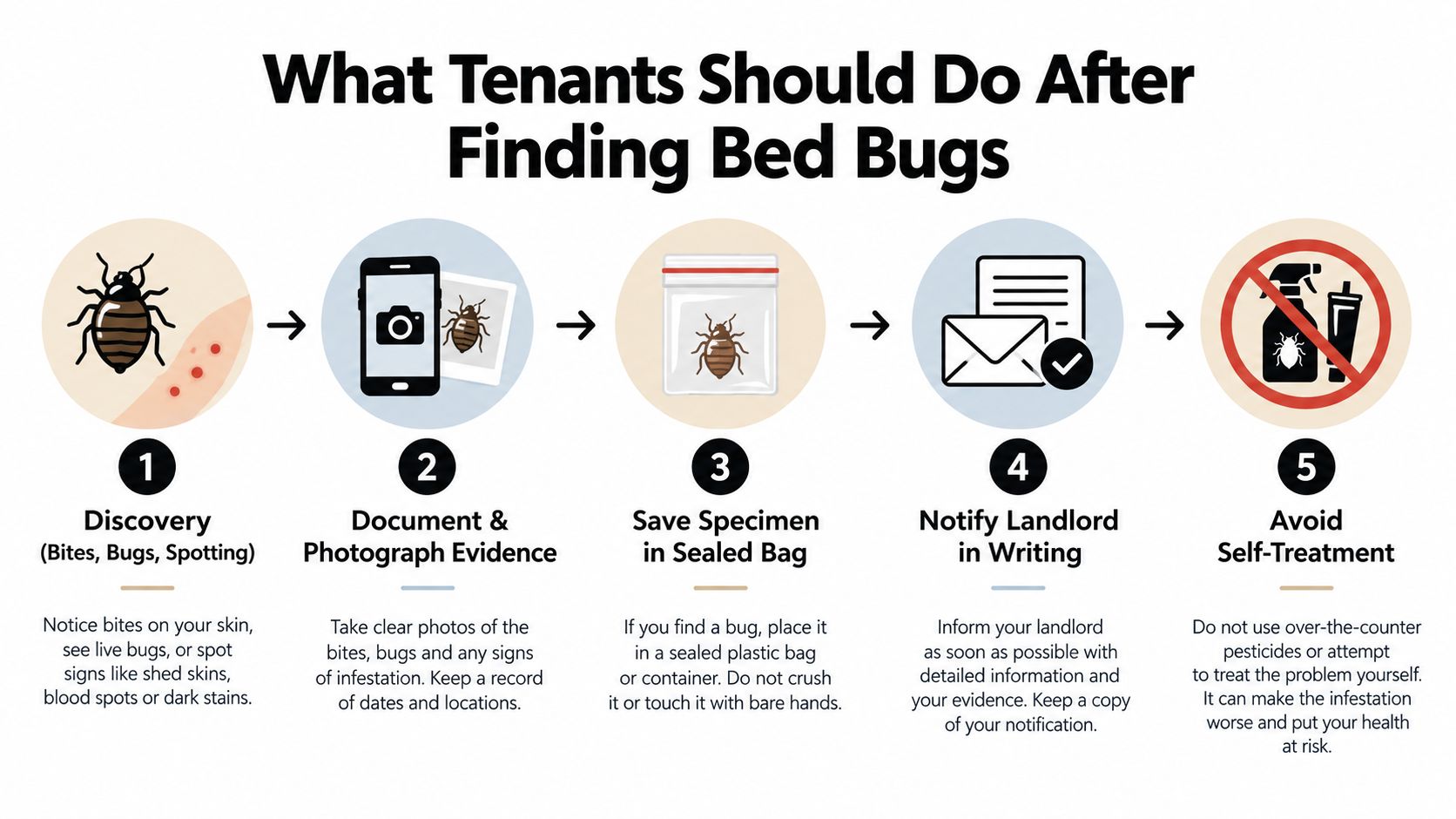
Create a written notice trail
Your notice should state:
- The unit: Include the property address and apartment number.
- The date: Record when you first observed bugs, spotting, or suspected activity.
- The evidence: Describe what you found and attach clear photographs.
- The request: Ask for inspection, identification, and appropriate treatment.
- The access plan: Offer reasonable times for inspection and treatment.
Send the notice through the method required by the lease. If the lease permits email, send an email and keep the sent message. You can also use the landlord's resident portal or another written channel that creates a reliable timestamp. Keep copies of everything.
Don't stop paying rent because the condition is upsetting. Texas repair remedies can depend on current rent, and nonpayment may lead to an eviction case. Before withholding rent, deducting costs, or moving out, speak with a Texas landlord-tenant attorney about the facts and the required procedure.
For additional context, review this resource on bed bugs and apartment tenant rights in Texas. A practical Kingwood bed bug treatment guide can also help you understand preparation and treatment questions, though it isn't a substitute for legal advice.
Cooperate and track the response
Allow the pest professional to inspect and follow preparation instructions. Save written directions about laundering, decluttering, encasing mattresses, or leaving the unit during treatment. Track inspection dates, treatment visits, follow-up findings, replacement expenses, laundry costs, and temporary housing expenses.
If the landlord delays, send a written reminder that references the original notice and asks for a specific response. A tenant may also consider a local code complaint or legal consultation. A landlord generally can't use self-help measures to remove a tenant. The restriction on Illegal Lockouts and Utility Shutoffs in Texas comes from Chapter 92's limits on self-help lockouts and utility interruptions.
How Landlords Should Respond to a Report
A landlord's first response should be calm, written, and investigative. Confirm receipt of the tenant's report, identify the next action, and arrange a prompt inspection by a qualified pest-management professional. Don't accuse the tenant or deny responsibility before the property and the evidence have been reviewed.
The inspection should confirm the species, locate activity, and consider whether neighboring units or common areas may be involved. A one-unit response may be inadequate if the infestation has a building-related source. The landlord should also review the lease's notice, access, preparation, and cost-allocation provisions.
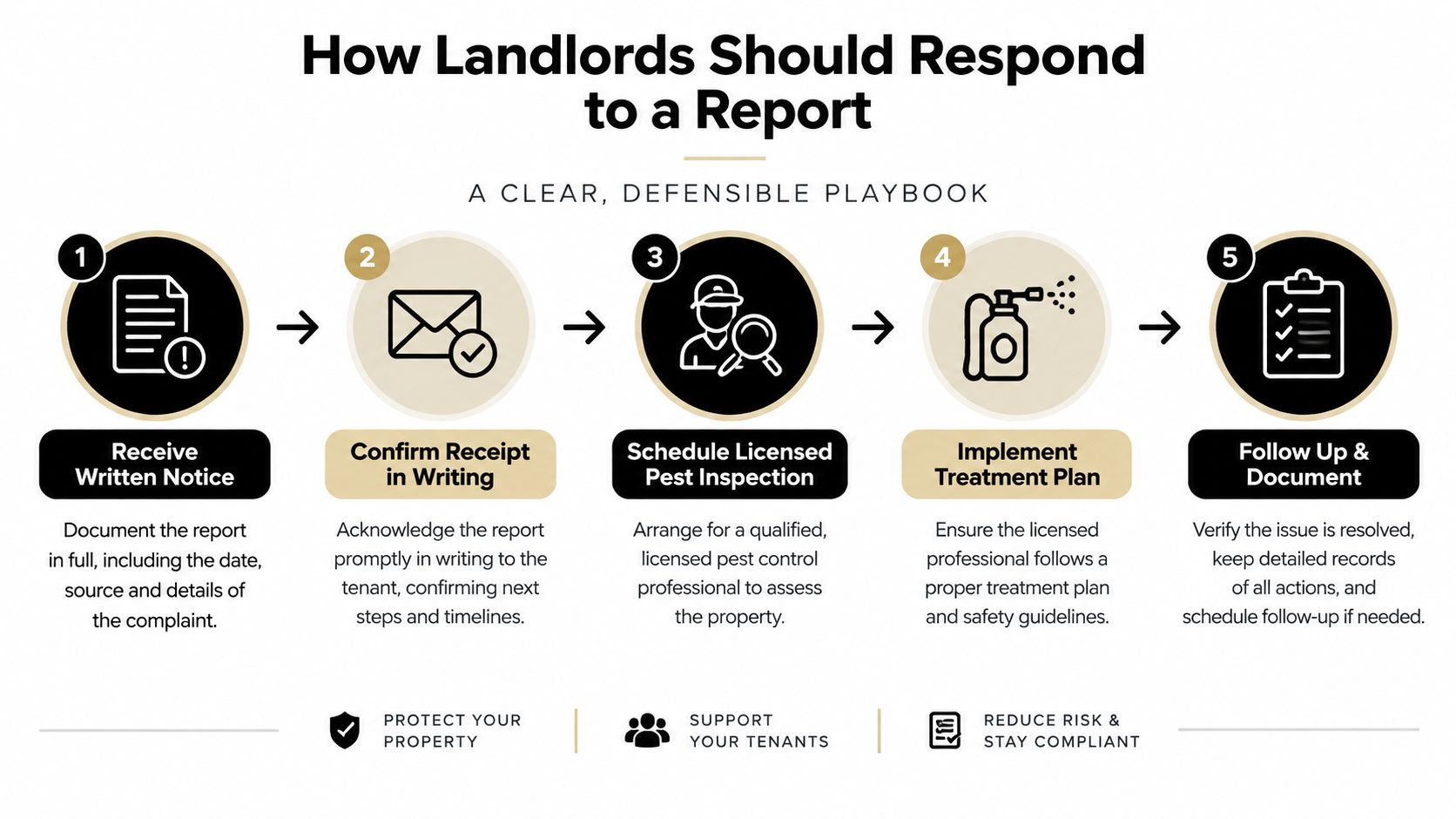
Build a defensible response file
A useful file contains:
- The notice record: Preserve the tenant's original report, receipt confirmation, and later communications.
- The inspection report: Keep the professional's identification, findings, photographs, and source observations.
- The treatment plan: Record the selected protocol, preparation instructions, access arrangements, and follow-up schedule.
- The property review: Note whether adjacent units, shared spaces, or other likely sources were inspected.
- Verification: Save post-treatment findings and any additional treatment recommendations.
Bed bugs often require more than a single visible-surface treatment. The response may involve chemical or heat protocols, encasements, repeat visits, and cooperation from several occupants. The landlord should communicate those requirements clearly and document whether the tenant followed them.
The landlord should also respond appropriately if a city or code official becomes involved. A reimbursement or rent adjustment may be appropriate in some situations, but it should be evaluated against the lease, the evidence, and the potential habitability dispute. A Texas landlord should consider legal advice before charging the tenant, issuing a lease violation, or taking action that could look retaliatory.
This overview of landlord responsibilities in Texas provides related context. Commercial property owners should also remember that Commercial Lease Disputes in Texas involve different treatment of commercial tenancies under Chapter 93.
The following video may help property managers think through practical pest-response considerations:
Two Scenarios That Change the Outcome
The same discovery can produce different legal results because timing and conduct change the evidence. Consider two simplified examples.
In Scenario A, a long-term tenant in a multi-unit complex sends prompt written notice, remains current on rent, allows inspection access, and follows preparation instructions. The tenant sends repeated reminders, but the landlord ignores them for weeks without arranging meaningful inspection or treatment. Those facts create strong evidence supporting landlord responsibility and may expand the tenant's potential remedies, subject to proof and the applicable legal requirements.
In Scenario B, a tenant brings used furniture into the unit, conceals signs of infestation, refuses reasonable preparation instructions, and stops paying rent. The landlord's exposure may narrow because causation and tenant noncooperation become central issues. The tenant may bear more of the cost, but the final result would still depend on the lease, inspection findings, notice history, and other evidence.
| Factor | Scenario A: Landlord Likely Responsible | Scenario B: Tenant Likely Responsible |
|---|---|---|
| Notice | Prompt written report with dates and evidence | Delayed or concealed report |
| Rent | Rent remains current | Tenant stops paying rent |
| Access | Tenant permits inspection and treatment | Tenant refuses or limits access |
| Preparation | Tenant follows professional instructions | Tenant ignores required preparation |
| Causation | Possible pre-existing or adjacent-unit source | Used furniture or tenant conduct appears connected |
| Landlord response | Repeated reminders receive no meaningful action | Landlord investigates and documents the response |
| Likely dispute focus | Failure to repair and failure to abate | Tenant causation, cooperation, and nonpayment |
Neither scenario guarantees a court result. A tenant still must prove the required elements, and a landlord may have defenses that aren't visible in a short example. The comparison shows why a Texas landlord tenant lawyer will ask for the complete timeline rather than answer only from the fact that bed bugs were found.
Available Remedies and Potential Damages
A tenant who proves that a landlord received proper notice and failed to make a required repair may have several possible remedies under Texas law. The available relief can include a court order requiring action, reimbursement of reasonable expenses, rent offsets or refunds, and other relief recognized by the repair-and-remedy framework. Texas tenant-rights guidance specifically identifies possible court orders, expense reimbursement, and rent offsets or refunds when the stated conditions are met and the landlord fails to act.
A tenant may also argue for rent abatement during a period when the premises were materially uninhabitable, actual damages connected to the condition, or termination and relocation relief where the legal requirements are satisfied. Those claims depend on causation, notice, severity, proof of expenses, and the landlord's response. A court won't treat every bite, purchase, or inconvenience as automatically recoverable.
Don't confuse remedies with self-help
Tenants often make four dangerous assumptions:
- “I can stop paying rent.” Unilateral withholding may support a nonpayment eviction.
- “I can deduct any treatment bill.” A self-help deduction may fail if statutory steps, notice, authorization, or proof aren't satisfied.
- “I can move out immediately.” Leaving without following the lease or legal procedure may create an abandonment or lease-breach dispute.
- “The landlord always pays.” Source, causation, lease terms, and tenant conduct still matter.
Statutory penalties or attorney's fees may be available in certain failure-to-repair, retaliation, or related claims, but they aren't automatic. A tenant should preserve the lease, notices, photographs, inspection reports, receipts, payment records, and communications before pursuing a case.
| Remedy | Texas Authority | Key Conditions |
|---|---|---|
| Repair order | Texas Property Code Chapter 92 and court procedures | Proper notice, qualifying condition, and landlord failure to act |
| Expense reimbursement | Repair-and-remedy framework | Reasonable documented expenses and proof connecting them to the condition |
| Rent offset or refund | Texas repair remedies | Statutory requirements, proof of the affected period, and causation |
| Rent abatement | Habitability principles and case-specific relief | Material impact on use, health, or safety |
| Lease termination or relocation-related relief | Applicable Texas law and lease terms | Serious condition, required notice, and compliance with procedure |
| Damages or attorney's fees | Applicable statutes and claims | A viable legal claim and proof of the required elements |
Before withholding rent, deducting costs, or moving out, ask an eviction attorney or Texas landlord-tenant lawyer to review the facts. A legally valid complaint can be weakened by an avoidable rent default or an unsupported deduction.
Prevention, Lease Terms, and Legal Help
Most bed bug disputes become easier to resolve when both sides create a clear record before a problem appears. Landlords can use move-in and turnover inspections, mattress encasements where appropriate, tenant education materials, and written reporting instructions. Tenants can photograph the unit's condition at move-in, read the pest provisions, and save every maintenance request.
Lease language deserves careful attention. A useful bed bug addendum may address reporting, access, inspection, preparation, professional treatment, follow-up visits, and cost allocation when evidence shows one party caused the infestation. It should be consistent with applicable Texas law and shouldn't rely on vague language that leaves both sides guessing.
A balanced prevention checklist
For tenants:
- Read the pest and repair provisions before signing.
- Report suspected activity in writing.
- Keep rent current while seeking legal advice about remedies.
- Permit reasonable inspection and treatment access.
- Save photographs, receipts, notices, and vendor instructions.
For landlords and managers:
- Provide a clear reporting channel.
- Confirm written notice and arrange professional inspection.
- Review adjacent units when the property layout creates a migration concern.
- Document treatment, preparation, follow-up, and verification.
- Consult counsel before charging a tenant or taking action that could create an eviction or retaliation dispute.
The Law Office of Bryan Fagan, PLLC handles Texas landlord-tenant disputes involving repairs, habitability, lease enforcement, evictions, and property rights. A free 30-minute consultation can help a tenant or property owner evaluate notice, causation, rent status, documentation, and the next legally sound step.
If bed bugs have created a repair dispute, payment concern, lease violation, or possible eviction issue, contact The Law Office of Bryan Fagan, PLLC for a free consultation. The firm can review your lease and written records, explain your tenant rights or landlord defenses, and help you choose a practical response before the dispute grows.