In Texas, a 3-day eviction notice under Property Code § 24.005 gives the tenant at least three written days from delivery to vacate, or cure the problem if the lease allows it, before a landlord can file a forcible detainer suit, unless the lease specifies a different period. The deadline depends on the lease, the delivery method, and the way Texas law counts the days.
A tenant may find a notice taped to the door after falling behind on rent. A landlord may be standing in the kitchen with an unpaid balance and no confidence that the notice form is correct. Both sides often ask the same urgent question: When does the three-day clock start, and what happens when it ends?
The answer matters because a notice delivered too early, served incorrectly, or counted under the wrong rule can create problems in court. A tenant who understands the deadline may still have time to pay, correct a lease violation, negotiate, or prepare a defense. A landlord who follows the lease and the Texas Property Code can avoid unnecessary delay and procedural mistakes.
This guide explains the law behind a 3 day eviction notice in Texas, how the calendar works under the January 1, 2026 counting rule, which service methods matter, what each side should do next, and which shortcuts can make the situation worse. For a broader explanation of the notice itself, review this Texas tenant guide to notices to vacate.
A Notice on the Door and a Clock You Didn't Start
A Houston renter comes home after work and sees a sheet of paper attached to the front door. The paper says the tenant owes rent and must move out within three days. The tenant reads it twice, then wonders whether the day of delivery counts, whether the weekend pauses the deadline, and whether paying part of the balance will stop a lawsuit.
Across town, a property owner may be facing the opposite problem. Rent is unpaid, the tenant's lease has ended, and the owner wants to act quickly. The owner knows that filing the wrong case or using the wrong notice can send the dispute back to the beginning.
Eviction is stressful for both sides, but the process becomes easier to understand when you separate it into distinct questions. What does the lease say? What does the notice say? How was it delivered? Which days count? Has the deadline expired?
Practical rule: The notice isn't the eviction itself. It is generally the pre-suit step that gives the tenant an opportunity to leave or address the claimed default before the landlord files in court.
A notice may arise from unpaid rent, another lease default, or a tenant staying after the rental term ends. The legal result can change based on the exact lease language and the facts surrounding delivery. A tenant shouldn't assume the paper is invalid just because it was unexpected, and a landlord shouldn't assume a paper is enforceable just because it was posted.
The safest approach is to preserve the notice, lease, payment records, messages, and photographs of the delivery location. Those records help show what happened and when. They also give a Texas landlord tenant lawyer or eviction attorney the information needed to evaluate the next step.
What the Texas Property Code Actually Says
Texas Property Code Chapter 24 governs forcible entry and detainer matters, which are the court cases commonly called evictions. The central notice rule appears in Texas Property Code § 24.005. For a tenant who defaults under a written lease or oral rental agreement, or who holds over after the lease term, the default rule is at least three days' written notice to vacate before the landlord files a forcible detainer suit. The statute also addresses tenants at will, tenants by sufferance, and occupants who obtained possession through forcible entry. Review the statutory language in Texas Property Code § 24.005.
The word default can include a failure to pay rent or another violation identified under the lease. Holding over means remaining in possession after the rental term ends when the landlord is entitled to possession. These categories are different from a landlord asking a tenant to move out informally. A valid notice must connect to the legal basis for seeking possession and comply with the applicable agreement.
The lease comes first
The three-day period is a statutory fallback, not an automatic answer for every rental. Section 24.005 allows the parties to agree in the written lease to a shorter or longer notice period. That means a landlord and tenant should read the notice provision before counting any deadline.
The lease may also explain whether the tenant has a right to cure a default, how rent must be paid, and how notices must be delivered. A notice to vacate and a demand to cure aren't always the same document or remedy. The exact wording can determine whether paying the amount claimed, fixing a condition, or moving out is the practical response.
A lease's key terms and required disclosures can be reviewed through What a Texas Lease Should Include. Separately, tenants should learn the basic definitions and protections found in Texas Property Code Section 92 and tenant rights.

Other Texas Property Code provisions may matter alongside Section 24.005. For example, Chapter 92 contains rules involving repairs, landlord retaliation, and residential landlord-tenant relationships, while § 92.001 provides important statutory definitions. Those provisions don't replace the notice rule, but they may affect whether a landlord's action is lawful or whether a tenant has a defense.
How to Count the Three Days the Right Way
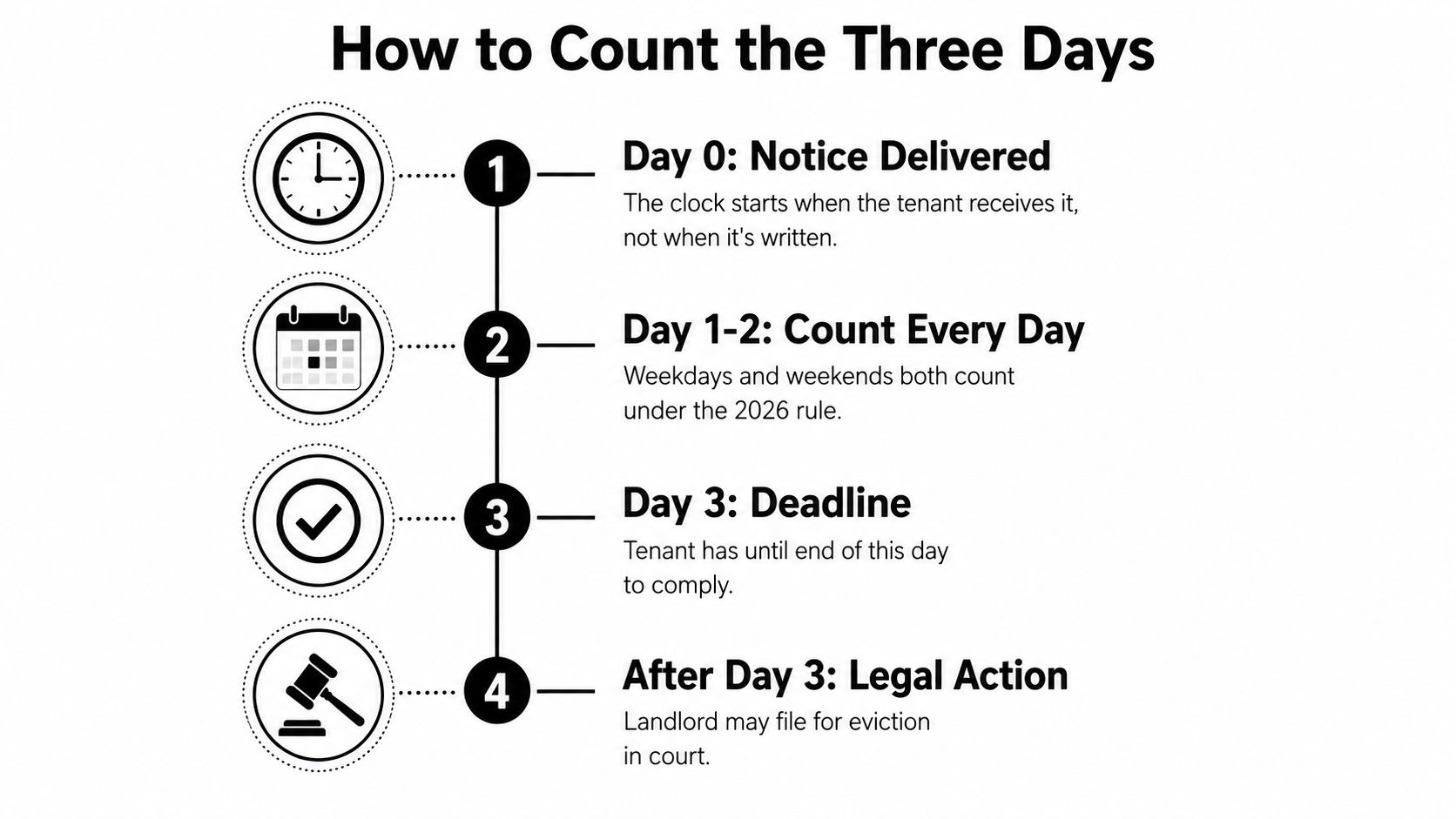
The clock starts when the notice is delivered, not when the landlord writes or signs it. Texas guidance explains that weekends and holidays are counted unless the lease provides another rule. Effective January 1, 2026, Texas Property Code § 24.0042 codified the counting method for Chapter 24 notices. Saturdays, Sundays, and state or federal holidays count, and the deadline extends only when the last day falls on a weekend or holiday. See the current statutory text in Texas Property Code Chapter 24.
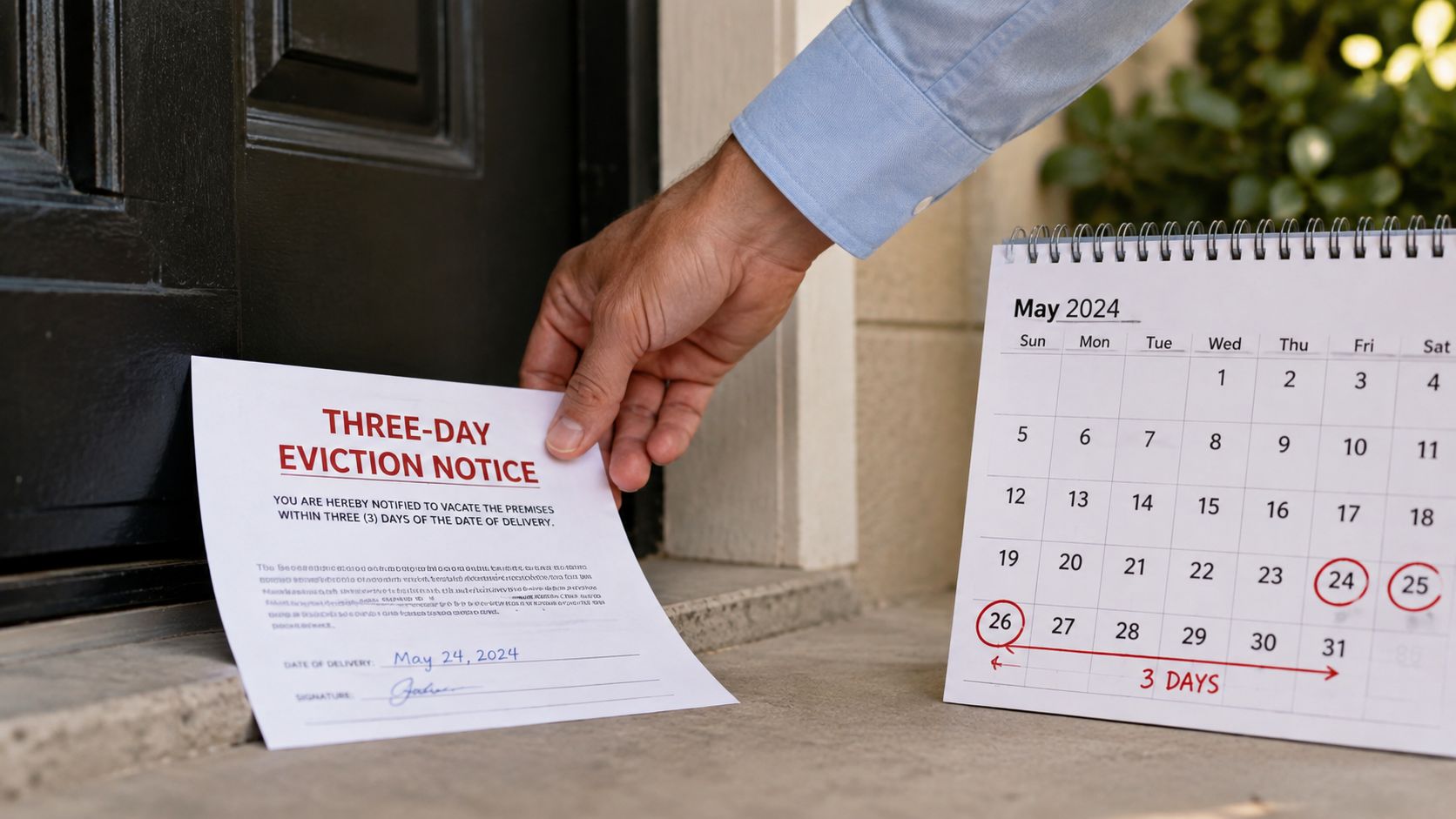
Consider a notice delivered on Tuesday at 4 p.m. Under the ordinary three-day count, Tuesday is the delivery day, Wednesday is the first counted day, Thursday is the second, and Friday is the third. Unless the lease states otherwise, the tenant generally has through the end of Friday to comply with the notice's demand before the landlord may file.
The time of day can still matter as evidence of delivery, even though the rule is generally discussed by calendar days. Keep the actual delivery date and method in writing. Don't rely on memory or an estimate from a text message.
What happens when the last day is a weekend
Suppose the count would place the third day on Saturday. Saturday still counts as part of the notice period, but the deadline is extended because the last day falls on a weekend. The same principle applies when the last day falls on a state or federal holiday. The extension doesn't mean every weekend pauses the count. It affects the deadline only when the final day lands on one of those days.
This is why a simple calendar note is safer than counting only business days. The January 1, 2026 rule makes weekends and holidays part of the count, while shifting the deadline when the final day is a weekend or holiday.
Use this checklist:
- Read the lease: Confirm whether it sets a shorter or longer period.
- Identify delivery: Record when the tenant received the notice.
- Count every day: Include Saturdays, Sundays, and state or federal holidays.
- Check the final day: Extend the deadline if the last day falls on a weekend or holiday.
- Wait for expiration: A landlord generally can't file before the notice period ends.
For related examples involving different agreements, review Texas notice periods by lease type. If the date is disputed, preserve proof of delivery and seek legal advice before relying on a calendar calculation.
Three Legal Ways to Serve a 3 Day Notice
A notice only helps a landlord if the landlord can prove lawful delivery. Texas law recognizes personal delivery to the tenant, delivery to an occupant at the premises who is at least 16 years old, and mailing to the premises. The delivery method affects when the notice is received and therefore can affect the earliest lawful filing date.
Personal delivery
The landlord or an authorized person may hand the notice to the tenant. The notice may also be delivered to a person residing at the premises who is at least 16 years old. The landlord should record the date, approximate time, location, and identity of the person who received it.
Personal delivery often provides the clearest evidence of actual receipt. It can also start the clock sooner than a mailing method when the tenant is available. A signed acknowledgment can help, but a landlord shouldn't create a confrontation or force the tenant to sign.
Mailing
Mailing the notice to the rental premises is another recognized method. The landlord should retain a copy of the notice and proof showing when and how it was mailed. Mail isn't the same as sending a text, email, or informal message, and the date relevant to the deadline may depend on the legally recognized delivery method and applicable lease language.
A mailed notice may be useful when personal delivery isn't practical, but it requires careful documentation. If the landlord can't establish that the notice was properly sent, the tenant may challenge whether the notice period ever began.
What doesn't start the clock
A text message, email, voicemail, or verbal statement generally doesn't substitute for the statutory notice method. Leaving a loose note on the doorstep also shouldn't be treated as automatically valid service. The landlord should follow the statute and the lease rather than assume the tenant's actual knowledge cures every defect.
Keep a service file: Save the notice, delivery records, photographs, mailing receipts, and any communication about receipt.
For a quick practical comparison, personal delivery can offer direct proof, mailing can provide a documented alternative, and an informal message may provide neither the required service nor reliable evidence. The method chosen should balance urgency with proof. A fast but undocumented attempt can create more delay than a carefully documented delivery.
After the Notice Is Served, Now What
The delivery date begins a short period in which the parties should act deliberately. A tenant shouldn't ignore the paper, and a landlord shouldn't treat the notice as permission to bypass the court process.
Steps for the tenant
First, read every line. Identify the claimed default, the amount or conduct described, the move-out date, and any lease provision referenced. Compare the notice with the signed lease and your records.
Next, decide whether the problem can be corrected. If the notice concerns unpaid rent, gather payment confirmations, bank records, receipts, and messages. If it concerns another breach, document what happened and whether the lease gives you an opportunity to cure. Don't assume that a partial payment or promise automatically cancels the notice. The lease and the landlord's written agreement matter.
Then create a response file:
- Lease copy: Include every page, addendum, and renewal.
- Payment proof: Save receipts, account screenshots, and bank records.
- Condition evidence: Keep photographs, videos, repair requests, and inspection notes.
- Communication history: Preserve texts, emails, letters, and call details.
- Legal questions: Write down what you need answered before the deadline.
Contacting a tenant-rights organization or an attorney early can help you evaluate defenses, negotiate, or prepare for court. A tenant who moves out should also clarify possession, keys, belongings, rent, and damages in writing.
Steps for the landlord
Confirm that the lease permits the notice period used. Verify the delivery method, date, and person served. If the tenant cures or pays, document whether the landlord accepts that resolution and what obligations remain.
If the tenant doesn't leave or resolve the stated default, the landlord generally must file a forcible detainer suit in the Justice Court serving the precinct where the property is located. The court process includes filing, service of the court citation, a hearing, judgment, and any appeal or later possession procedure. The hearing is often set within a few weeks, depending on the court and service.
A landlord must not change the locks, remove belongings, shut off utilities, or use threats to force the tenant out. The notice period isn't a license for a self-help eviction. Possession should be recovered through the lawful court process.
The central filing rule is simple: A landlord generally can't file the eviction case until the applicable notice period has expired.
Tenants who receive a court citation should attend the hearing and review the available response options. If a judgment is entered, a party may need to act quickly to preserve an appeal. The firm's information on a Texas eviction appeal can help explain that next stage.

Two Real-World Scenarios That Show How This Plays Out
In the first scenario, a Houston tenant falls behind on rent and receives a written notice. The tenant checks the lease before responding and discovers that the agreement addresses both the notice period and whether the tenant can cure nonpayment.
The tenant pays part of the claimed balance during the notice window and sends the landlord a written promise to pay the rest. The landlord responds in writing, explaining whether the partial payment is accepted as a cure, accepted only as a partial payment, or rejected under the lease. That written exchange is important because accepting money doesn't automatically answer whether the landlord has waived the right to pursue possession.
The tenant also keeps the lease, payment records, and the notice. If the landlord files anyway, those documents may help the tenant explain what was paid, what was promised, and what the lease required. The lesson isn't that partial payment always stops an eviction. The lesson is that the lease and written communications control the practical meaning of the payment.
The second scenario involves a Dallas property transferred after a sale. The occupant is a tenant at will who remains in possession after the prior arrangement ends. The new owner wants possession quickly, but the owner first reviews the lease or rental agreement, confirms the occupant's status, and chooses a recognized service method.
Because timing is important, the owner records the date and method of delivery instead of relying on a casual conversation. The owner then waits for the applicable notice period to expire before filing in the appropriate Justice Court. If the owner posts a paper, the owner also needs to consider whether the chosen posting method satisfies the statute and the lease.
Both examples show why a notice isn't just a form. Wording, cure rights, lease terms, service, and calendar counting work together. A tenant's best move is to respond with documents. A landlord's best move is to build a clear record before asking a court for possession.
Common Mistakes and Misconceptions That Cost People
“Three business days” means weekdays only. Under the January 1, 2026 counting rule, Saturdays, Sundays, and state or federal holidays count in the notice period. The deadline extends when the final day falls on a weekend or holiday, not every time a weekend appears in the count.
“A text or email is enough.” Informal messages may show that the tenant knew about a dispute, but they don't automatically replace the statutory service methods. A landlord should use a legally recognized method and preserve proof.
“I can change the locks after the notice expires.” The expiration of the notice doesn't give a landlord automatic possession. Locking out a tenant or removing belongings without following the lawful process can expose the landlord to liability.
“A verbal demand is enough.” A landlord may tell a tenant that rent is overdue, but a conversation isn't the same as the written notice required for a forcible detainer case. Written records reduce disputes about what was said and when.
“I don't have to leave immediately.” A tenant generally doesn't lose possession the moment a notice arrives. But ignoring the deadline can lead to a court filing, and leaving without addressing rent, damages, keys, or written agreements may not resolve every financial dispute.
Your Next Move and How We Can Help
Start with the issue you can verify. If you're a tenant, locate the lease, preserve the notice, confirm the delivery date, and gather payment or repair records. If you're a landlord, compare the lease with the notice, document service, calculate the deadline under § 24.0042, and avoid any lockout or other self-help action.
Three rules should guide the response. Section 24.005 supplies the default three-day notice, but the lease may change the period. Section 24.0042 controls the calendar after January 1, 2026, including weekends, holidays, and a final-day extension. The service method determines when delivery occurred, which affects when the notice period begins.
If a real estate transaction is creating the dispute, careful review of possession rights and lease obligations can help parties reduce risk in real estate closings. A landlord may also need help preparing a notice or eviction filing, while a tenant may need help challenging service, responding to a default, or protecting tenant rights.
The Law Office of Bryan Fagan, PLLC handles Texas landlord-tenant disputes involving notices to vacate, evictions, lease enforcement, repairs, retaliation, and related property issues. A Texas landlord tenant lawyer or eviction attorney can review the actual lease and delivery record instead of relying on a generic deadline.
If you need help with a 3-day notice, lease issue, or rental dispute, The Law Office of Bryan Fagan, PLLC can review your documents, explain your options, and help you plan the next step. Schedule a free consultation by visiting The Law Office of Bryan Fagan, PLLC today.